Online Catalogue with all Lots / Auction 160
Modern and Contemporary Art
Saturday, 11 July 2026 at 11:00 am - After sale
Lot 31 Julije Knifer. Mäander. 1985. Mappe mit 5 …


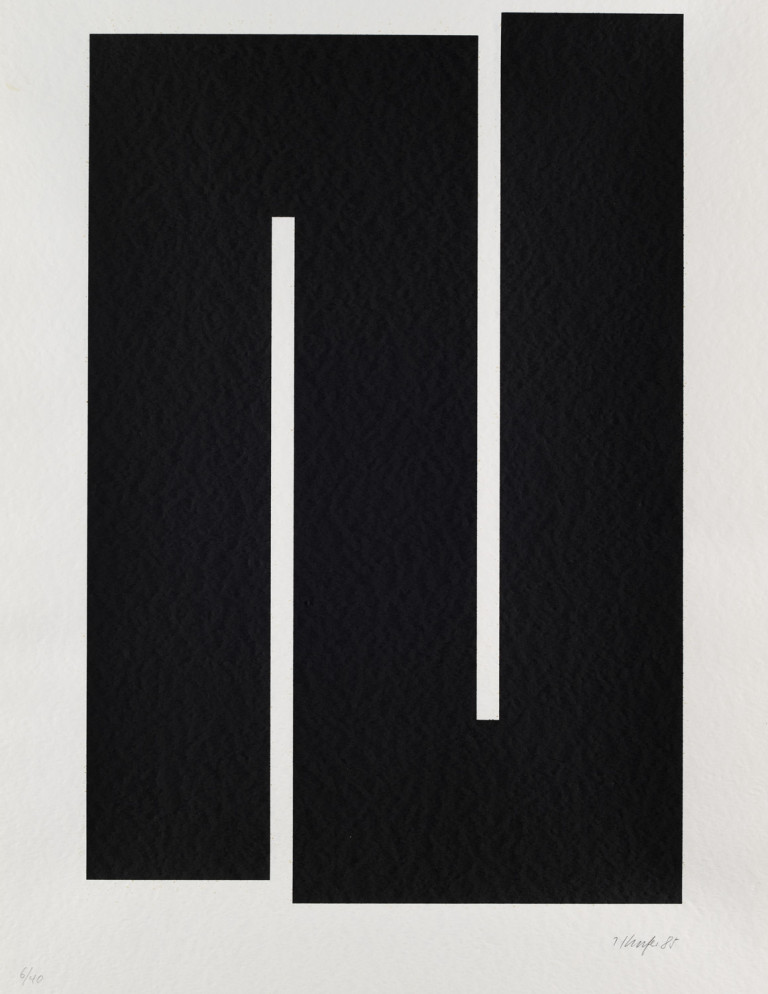
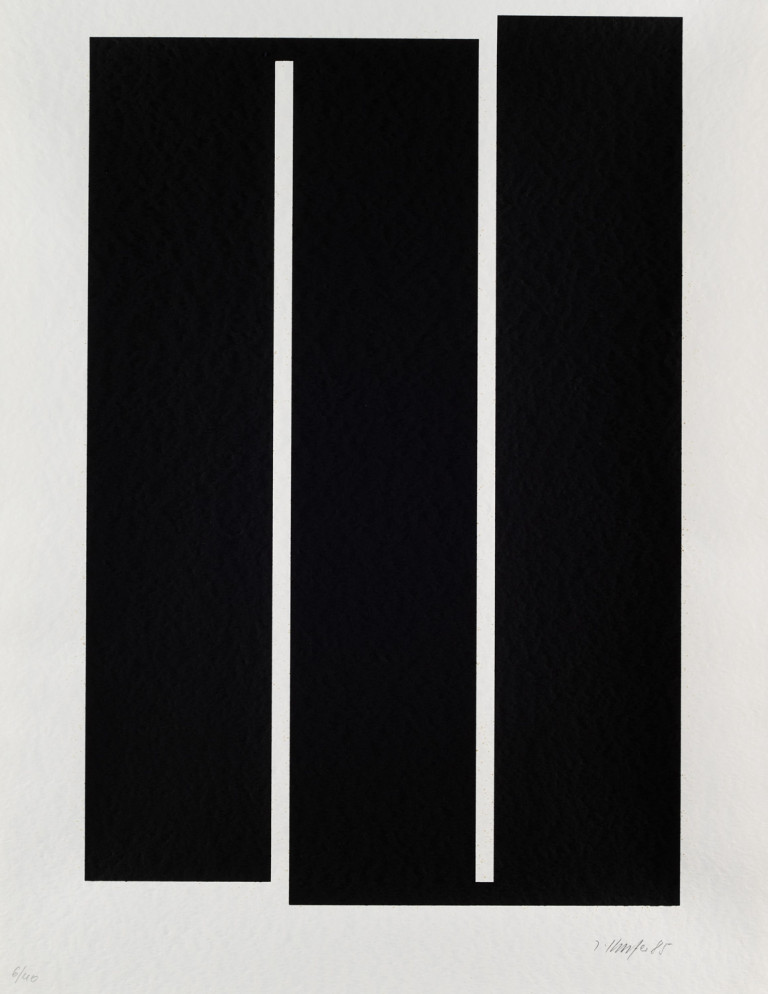
Mäander. 1985. Mappe mit 5 Siebdrucken. 58,7 x 38.7 cm (66 × 51 cm.) Je signiert, datiert und nummeriert. - Kleine Braunflecken von verso nach recto durchschlagend, verso mit leichten Flecken, Papier technikbedingt dezent gewellt. Insgesamt sehr gut. Prachtvolle, tiefschwarze Drucke.
Geometrische Abstraktion – Eins von 40 Exemplaren. - Herausgegeben von der Edition Hoffmann. - Das einzige Bildmotiv, der Mäander, ist eine aus ausschließlich horizontalen und vertikalen Linien gefügte, rechtwinklig-labyrinthartige Form in Schwarz und Weiß, auf die sich Knifer Ende der 1950er Jahre als sein absolutes, lebenslanges Sujet festlegte. In den 1980er Jahren verlagerte Knifer seinen Arbeitsprozess ins Zeichnerische: Er trug Graphit in stundenlangen Schichtungen auf Papier auf, sodass die Blätter nicht als sauber gedruckte Flächen erscheinen, sondern die taktile Zeitlichkeit des Auftragens selbst konservieren. Knifer verstand diese Arbeiten als "Zeitaufzeichnungen" (records of time) und näherte sich damit konzeptuell On Kawaras Date Paintings oder Roman Opalkas Zahlenlisten an - Serialität als Form von Widerstand gegen Abgeschlossenheit und Eindeutigkeit. Kunsthistorisch speist sich Knifers Ansatz aus dem russischen Suprematismus (Malewitsch) und dem Konstruktivismus, den er während seiner Ausbildung in Zagreb internalisiert hatte, und verbindet sich durch seine Mitgliedschaft in der Gorgona-Gruppe mit der osteuropäischen Neo-Avantgarde der 1960er Jahre. Die Graphit-Mappen der Edition Hoffmann stellen so einen Knotenpunkt dar, an dem Konkrete Kunst, serielle Minimal-Art und konzeptuelle Anti-Kunst zu einem singulären, buchstäblich unabschließbaren Bildprojekt zusammenfallen. Das Torchon-Bütten - ein schweres, handgeschöpftes oder rundsiebgefertigtes Papier mit ausgeprägter, leinenartiger Oberflächentextur - gibt beim Siebdruckverfahren seine Struktur sichtbar in die Druckfläche weiter. Die Farbe folgt dem Relief der Papierkörnigkeit, statt sie gleichmäßig zu bedecken: Auf den erhabenen Faserbündeln sitzt die Graphit-Siebdruckfarbe dicht, in den Vertiefungen bleibt das Weiß des Papiers sichtbar - die Druckfläche "atmet" die Papierstruktur durch.
Geometrical Abstraction – Portfolio of 5 screenprints. Each signed, dated and numbered. - Small brown spots showing through from the verso to the recto, light spotting to the verso, paper slightly undulated, inherent to the technique. Overall in very good condition. Magnificent, deep-black prints. One of 40 copies. - Published by Edition Hoffmann. - The sole pictorial motif, the meander, is a right-angled, labyrinthine form composed exclusively of horizontal and vertical lines in black and white, which Knifer adopted in the late 1950s as his absolute, lifelong subject. In the 1980s, Knifer shifted his working process towards drawing: he applied graphite in layers over hours, so that the sheets do not appear as cleanly printed surfaces but rather preserve the tactile temporality of the act of application itself. Knifer understood these works as records of time, aligning them conceptually with On Kawara's Date Paintings or Roman Opalka's number sequences - seriality as a form of resistance against closure and singularity of meaning. Art-historically, Knifer's approach draws on Russian Suprematism (Malevich) and Constructivism, which he had internalized during his training in Zagreb, and connects, through his membership in the Gorgona Group, with the Eastern European neo-avant-garde of the 1960s. The graphite portfolios of Edition Hoffmann thus constitute a nodal point at which Concrete Art, serial Minimal Art and conceptual anti-art converge into a singular, literally inexhaustible pictorial project. The torchon laid paper - a heavy, handmade or cylinder-mould paper with a pronounced, linen-like surface texture - imparts its structure visibly into the printed surface during the screenprinting process. Rather than covering the paper's relief evenly, the ink follows the grain: on the raised fibre clusters the graphite screenprint ink sits dense and full, while the white of the paper remains visible in the recesses - the printed surface breathes the paper's own texture through.
Result: 7000 €
Premium and taxation
This piece is subject to differential taxation. There is a 29,5% buyer's premium on the hammer price. The value added tax is included but not displayable according to §25a UstG.
Shipping
A pickup of this work is possible in our premises at Potsdamer Str. 16, 14163 Berlin by appointment. If you wish a shipment of the work, please contact us for a consultation and shipping calculation. Framed tickets are shipped exclusively by a shipping company due to the risk of breakage. Postal shipping is only carried out at the express request and risk of the buyer.
Terms and Conditions
You can view our terms and conditions here
Droit de Suite
On the sales proceeds of all original works of fine art and photography, whose authors have not yet died 70 years before the end of the sale, an additional 2% (subject to change) of the hammer prices from 400€ will be charged pro rata for the VG Bild-Kunst, which represents the copyrights of visual artists according to § 26 UrhG.
Submit a bid
I would like to participate in your auction by accepting the General Terms and Conditions of Jeschke van Vliet Auctions Berlin GmbH.