Online Catalogue with all Lots / Auction 159
From noble estates and bourgeois property.
Rare Books, Prints, and Classical art
Saturday, 25 April 2026 at 10:00 am - After sale
Lot 172 Fragment einer …
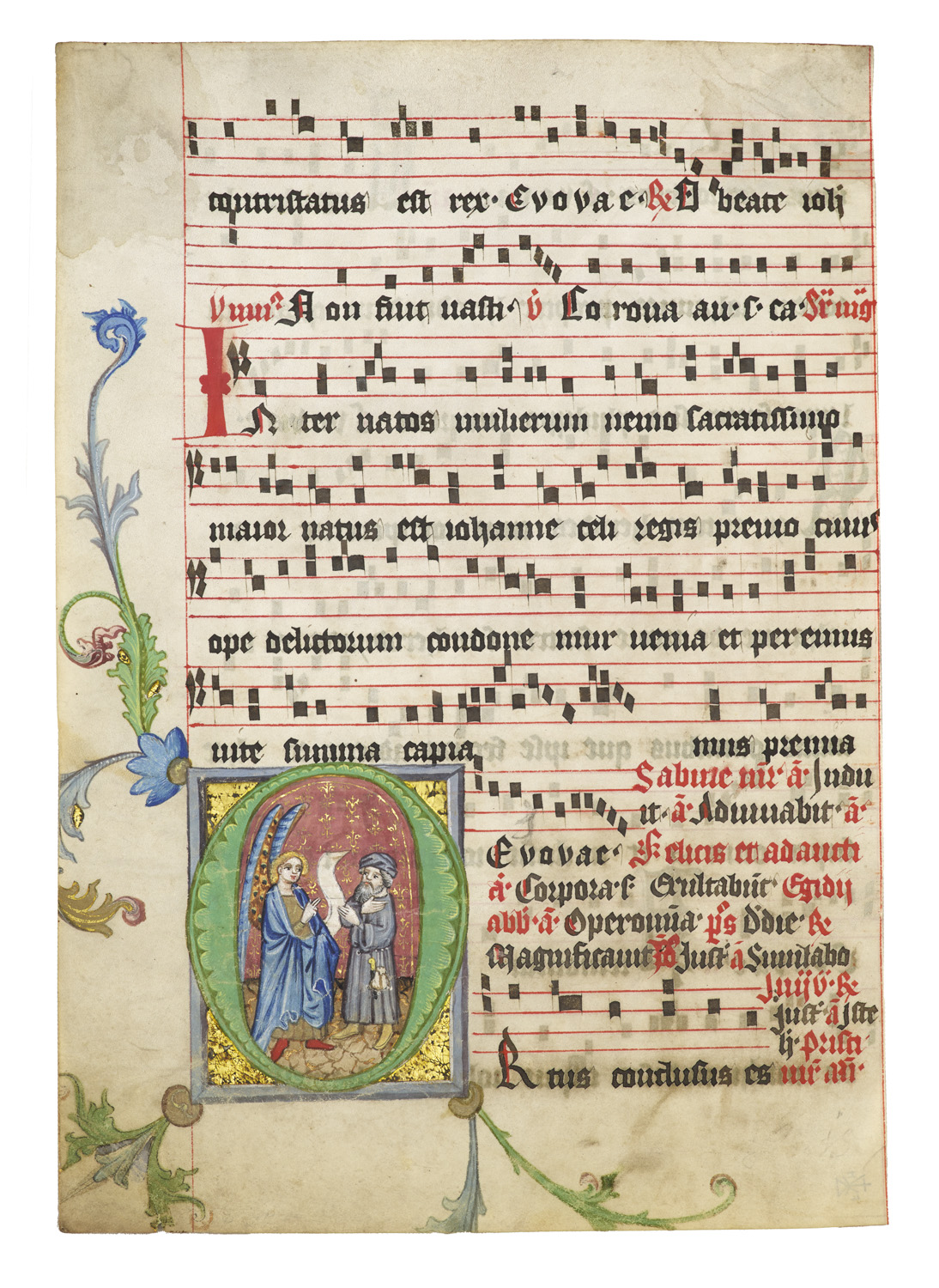
Fragment einer spätmittelalterlichen liturgischen Musikhandschrift, wahrscheinlich ein Graduale oder Antiphonar mit gregorianischem Gesang. Mit einer prachtvollen goldgehöhten Initiale und zahlreichen dekorativen Lombarden, sowie reichem vegetabilen Rankenwerk. 21 Zeilen. Eine Spalte. Lateinische Handschrift auf Pergament. Gotischen Textualis formata (Textura). Schriftraum ca. 34 x 22,3 cm. (38,3 x 26,6 cm). Frankreich oder England, 14. Jahrhundert, (um 1300-1350).
Mittelalter
Manuskripte und Urkunden – Zur PALÄOGRAPHIE: Die Buchstaben sind in einer gotischen Textualis formata (Textura) gehalten, mit schmalen, vertikalen Ascendenzen und Descendenzen, typisch für Buchschriften ab ca. 1250. Abkürzungen wie "q~" (que), "s¯" (super) und "n¯" (rum/-nam) sind standardmäßig mittelalterlich, Ligaturen (z.B. "æ") und Rubriken in Rot kennzeichnen liturgische Texte. Die Schreibrichtung ist linksbündig mit gotischen Proportionen (hochformatig, komprimiert). Zum INHALT: Die Phrase "Inter natos mulierum nemo sacratissimo maior natus" verankert das Blatt eindeutig in der Liturgie zu Johannes dem Täufer und bestimmt damit den Inhalt als Johannes-Feier (meist Geburt oder Enthauptung Johannes des Täufers). Sie greift wörtlich die biblisch-liturgische Antiphon "Inter natos mulierum non surrexit maior Iohanne Baptista" auf. Der Wortlaut geht auf die Worte Jesu in Mt 11,11 bzw. Lk 7,28 zurück: "maior inter natos mulierum propheta Iohanne Baptista nemo est" - "Unter allen von Frauen Geborenen ist kein größerer Prophet als Johannes der Täufer." Zur INITALE: Der Engel richtet die Hände zum Gegenüber, der Mann hält die Rolle zwischen beiden Figuren - ikonographisch ein "Akt der Übermittlung" (Inspiration, Offenbarung, Belehrung). Die Seiten enthalten Choralgesang mit mehrfacher Nennung von "Iohannes" und Anspielungen auf Gericht, Lobpreis und Verkündigung, das legt eine Verbindung zur Johannes-Tradition nahe. Die Initial-Miniatur zeigt höchstwahrscheinlich Johannes (als Prophet/Prediger) im Moment der göttlichen Belehrung bzw. Berufung durch einen Engel, sie illustriert damit die im Text ausgesprochene Einzigartigkeit und Berufung des Täufers. Ein tiefes, leuchtendes Blau im Gewand des Engels und in Teilen des Rahmens, wahrscheinlich mit Azurit oder - bei besonders intensiver Sättigung - mit kostbarem Ultramarin (Lapislazuli) ausgeführt. Ein sattes Grün in Ranken, Blättern und im Rahmen der Miniatur, typischerweise aus Verdigris (Kupfergrün) oder Mischungen von Azurit mit Gelbpigmenten erzeugt. Ein kräftiges Rot in Hintergrundmustern und Details, das wohl auf Zinnober (Vermilion) oder Mennige (Rotblei) zurückgeht, diese Kombination von Rot und Blau auf Goldgrund ist in gotischen Chorbüchern besonders verbreitet. - Im oberen rechten Rand recto und verso mit leichtem Wasserfleck. - Verso mit dem Sammlerstempel von Frits Hasselmann (Lugt, L.1012). Seine Sammlung wurde zwischen 1889 und 1894 in mehreren Durchgängen versteigert. - Eindrucksvolles Exponat der Buchmalerei um 1350.
Manuscripts – Middle Ages - - Fragment of a late medieval liturgical music manuscript, likely a gradual or antiphonary containing Gregorian chant. Features a magnificent gold-embellished initial and numerous decorative Lombardic letters, as well as rich vegetal scrollwork. 21 lines. One column. Latin manuscript on parchment. Written in Gothic Textualis (Textura). France or England, 14th century (c. 1300-1350). On PALAEOGRAPHY: The letters are written in a Gothic textualis formata (textura), with slender vertical ascenders and descenders, typical of book scripts from about 1250 onwards. Abbreviations such as "q~" (que), "s¯" (super), and "n¯" (-rum/-nam) are standard medieval forms, ligatures (e.g. "æ") and rubrics in red identify it as a liturgical text. The writing is left-aligned, with Gothic proportions (tall and compressed). On THE CONTENT: The phrase "Inter natos mulierum nemo sacratissimo maior natus" firmly anchors the leaf in the liturgy of John the Baptist and thus defines its content as a celebration of John (usually the Nativity or the Beheading of John the Baptist). It literally takes up the biblical-liturgical antiphon "Inter natos mulierum non surrexit maior Iohanne Baptista." The wording goes back to the words of Jesus in Mt 11:11 and Lk 7:28: "maior inter natos mulierum propheta Iohanne Baptista nemo est" - "Among all those born of women there is no greater prophet than John the Baptist." On THE INITIAL: The angel stretches out his hands towards the figure opposite, while the man holds the scroll between the two figures - iconographically an "act of transmission" (inspiration, revelation, instruction). The pages contain choral chant with repeated mention of "Iohannes" and allusions to judgement, praise, and proclamation, which suggests a connection with the Johannine tradition. The initial miniature most likely shows John (as prophet/preacher) at the moment of divine instruction or vocation by an angel, thereby illustrating the uniqueness and calling of the Baptist as articulated in the text. A deep, luminous blue in the angel's robe and parts of the frame was probably executed with azurite or - in the case of particularly intense saturation - with precious ultramarine (lapis lazuli). A rich green in the vines, leaves, and the frame of the miniature was typically produced from verdigris (copper green) or mixtures of azurite with yellow pigments. A strong red in the background patterns and details most likely goes back to cinnabar (vermilion) or minium (red lead), this combination of red and blue on a gold ground is especially common in Gothic choir books. At the upper right margin, recto and verso, there is a slight water stain. Verso bears the collector's stamp of Frits Hasselmann (Lugt, L.1012). His collection was auctioned in several stages between 1889 and 1894. An impressive specimen of book illumination around 1350.
Result: 1200 €
Premium and taxation
This work is subject to under the regular margin scheme. There is a 24.95% buyer's premium on the hammer price and inside the EU 7% (Books, Paintings, Drawings and most Prints) and 19% (Photographs, Screen and Offsetprints, Autographs and Manuscripts) VAT on the final invoice amount.
Shipping
A pickup of this work is possible in our premises at Potsdamer Str. 16, 14163 Berlin by appointment. If you wish a shipment of the work, please contact us for a consultation and shipping calculation. Framed tickets are shipped exclusively by a shipping company due to the risk of breakage. Postal shipping is only carried out at the express request and risk of the buyer.
Terms and Conditions
You can view our terms and conditions here
Droit de Suite
On the sales proceeds of all original works of fine art and photography, whose authors have not yet died 70 years before the end of the sale, an additional 2% (subject to change) of the hammer prices from 400€ will be charged pro rata for the VG Bild-Kunst, which represents the copyrights of visual artists according to § 26 UrhG.
Submit a bid
I would like to participate in your auction by accepting the General Terms and Conditions of Jeschke van Vliet Auctions Berlin GmbH.