Online Catalogue with all Lots / Auction 159
From noble estates and bourgeois property.
Rare Books, Prints, and Classical art
Saturday, 25 April 2026 at 10:00 am - After sale
Lot 171 Fragment einer …
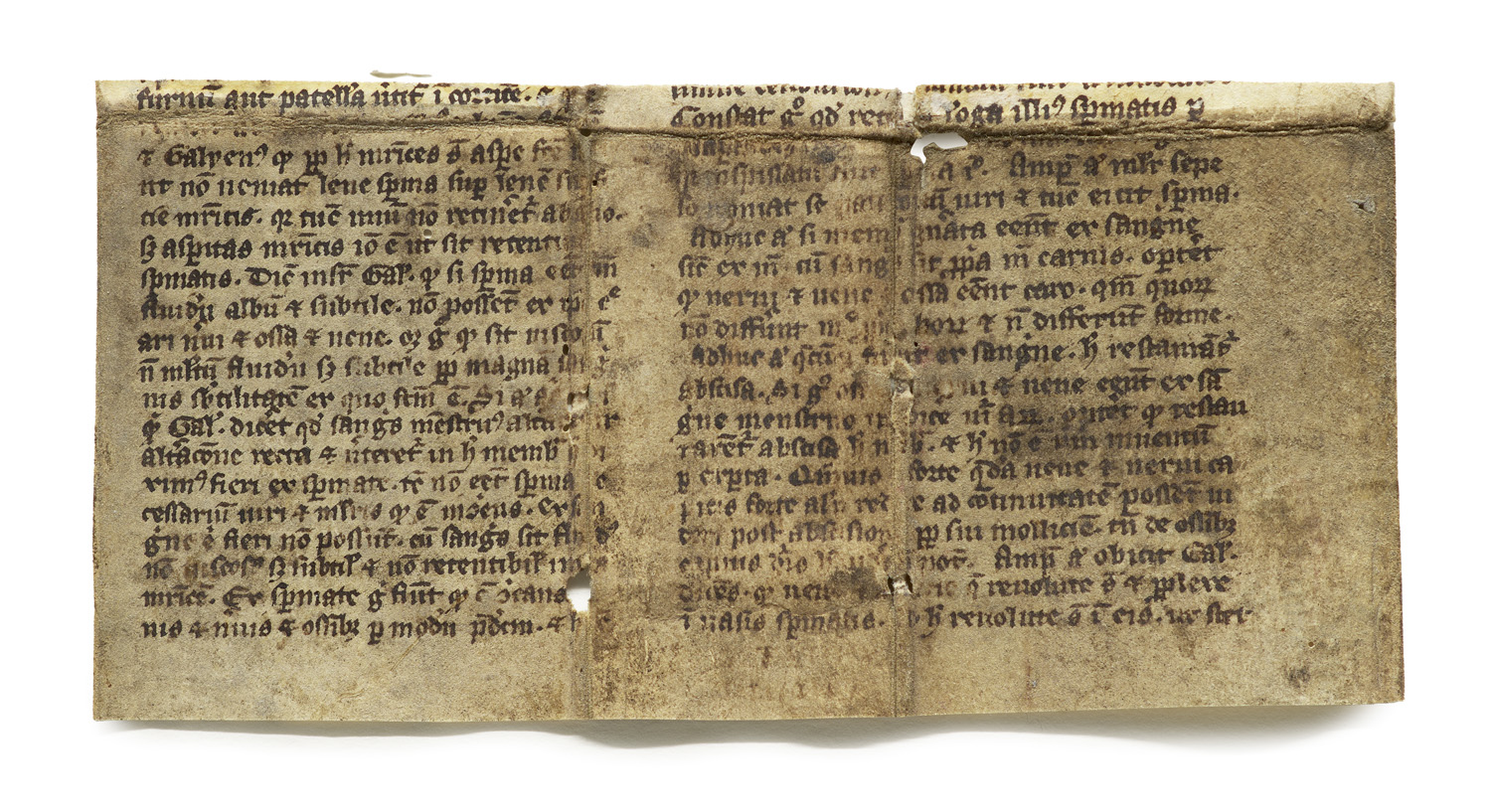
Fragment einer spätmittelalterlichen Handschrift. Aus der Pseudo Galen Tradition oder einem nah verwandten gynäkologischen Kompendium. 19 Zeilen. Lateinische Handschrift auf Pergament. Gotische Textualis. Schriftraum 9,1 x 17,6 cm,. Format: 10,6x 21, cm. Mitteleuropa, ca. zweite Hälfte 13. bis frühes 14. Jahrhundert (ca. 1270-1330).
Mittelalter
Manuskripte und Urkunden – Proveninenz: Nachlass eines Buchbinders. - Makulaturfragment aus einem Einband. - Zur PALÄOGRAPHIE: Die Schrift ist relativ regelmäßig und eher "Buchschrift" als Kursive (keine ausgeprägte Rechtsneigung, wenige Schleifen), also keine Bastarda oder ausgeprägte gotische Kursive, wie sie erst im späteren 14.-15. Jh. dominiert. Häufig sind typische hoch und tiefgestellte Kürzungszeichen (Tironisches et Zeichen, Überstriche zur Nasal Kürzung ). Der Abkürzungsgrad ist hoch, aber noch nicht extrem "spätgotisch überladen", genau diese Dichte begegnet man häufig in medizinischen Lehrhandschriften des 13./frühen 14. Jh. aus dem Universitätsumfeld (Paris, Bologna, Mitteleuropa). Zum INHALT: Das Fragment stammt aus einem scholastisch medizinischen Traktat, das galenische (bzw. pseudo galenische) Lehre zur Physiologie des Blutes und speziell zum Menstruationsblut referiert und mit moralisch theologischen Fragen (heiliges Blut Christi, sanguis sanctus) verbindet. Das Fragment erörtert in scholastisch medizinischer Prosa die Natur des Blutes mit besonderem Fokus auf das Menstruationsblut. Es zitiert "Galienus" und beschreibt einen feinen, "weißen" Blutanteil, der in Venen und Arterien mit den spiritus zirkuliert, nicht aber in Knochen, Gelenken oder Mark vorkommt. Aus diesem Blut entsteht durch "wahre Veränderung" das Menstruationsblut, das kein "sanguis restaurativus" für Nerven, Knochen und Mark ist und als überschüssig und nicht rückführbar gilt. Zugleich wird es vom "sanguis sanctus" unterschieden, in dem kein solcher irreversibel in Menstruum übergehender Anteil sein könne, und die physiologische Differenz zwischen Mann und Frau wird so erklärt, dass beide zwar dieselbe Bluts Natur haben, die Frau aber durch die Menstruation restauratives Blut verliert und dadurch an potentia corporis einbüßt. Der Inhalt passt eng zur galenisch pseudo galenischen Reproduktionslehre, insbesondere zur Tradition um den Traktat De spermate und verwandte salernitanische Kompendien, sodass das Stück wahrscheinlich aus einem medizinischen Lehrcodex des 13./frühen 14. Jahrhunderts mit Auszügen oder Kommentar zu einem solchen pseudo galenischen Werk stammt. Die Vorstellung, dass Blut durch Kochung in Venen und Arterien in verschiedene Säfte überführt wird, ist typisch für Galen und vor allem auch für pseudo galenischen Traktate wie Liber spermatis oder Microtegni, die im 12.-14. Jh. in lateinischer Übersetzung weit verbreitet waren. Die Kombination mit explizitem "sanguis sanctus"-Motiv könnte auch auf einen Traktat de generatione oder de sanguine verweisen, der medizinische und theologische Fragen (Reinheit, Eucharistie) verschränkt, solche Texte sind z.B. in Sammelhandschriften mit scholastischen Quaestiones zu Medizin und Theologie belegt. - Mehrfach gefalzt (geglättet), Verso mit Manuskriptresten und Kaschierung mit barocken Druckfragment, kleines Löchlein auf der linken Seite im Falz. Etwas verschmutzt. - Selten.
Manuscripts – Fragment of a late medieval manuscript. From the pseudo-Galenic tradition or a closely related gynaecological compendium. 19 lines. Latin manuscript on parchment. Gothic textualis. Writing space 9.1 × 17.6 cm. overall size 10.6 × 21 cm. Central Europe, about the second half of the 13th to the early 14th century (c. 1270-1330). Provenance: From the estate of a bookbinder. - Waste fragment from a binding. - Paleography: The script is relatively regular and is more a book script than a cursive (no pronounced rightward slant, few loops), thus not a bastarda or strongly developed Gothic cursive such as becomes dominant only in the later 14th-15th centuries. Abbreviation marks, both superscript and subscript, are frequent (Tironian "et" sign, overlines for nasal abbreviation). The degree of abbreviation is high but not yet "overloaded" in the late-Gothic manner, this density is typical of medical teaching manuscripts of the 13th / early 14th century from a university milieu (Paris, Bologna, Central Europe). Content: The fragment comes from a scholastic medical treatise that reports Galenic (or pseudo-Galenic) teaching on the physiology of blood and especially of menstrual blood, and combines it with moral-theological questions (the holy blood of Christ, sanguis sanctus). The fragment discusses, in scholastic medical prose, the nature of blood with a particular focus on menstrual blood. It cites "Galienus" and describes a fine, "white" portion of blood which circulates with the spiritus in veins and arteries but does not occur in bones, joints, or marrow. From this blood there arises, through "true alteration", menstrual blood, which is not "sanguis restaurativus" for nerves, bones, and marrow and is regarded as superfluous and not reversible. At the same time it is distinguished from the "sanguis sanctus", in which no such component that irreversibly passes over into menstruum can be present, and the physiological difference between man and woman is explained in such a way that both indeed have the same nature of blood, but the woman loses restorative blood through menstruation and thereby forfeits bodily potentia. The content fits closely with Galenic / pseudo-Galenic reproductive theory, especially with the tradition around the treatise De spermate and related Salernitan compendia, so that the piece probably stems from a medical teaching codex of the 13th / early 14th century containing excerpts from or a commentary on such a pseudo-Galenic work. The idea that blood, through "cooking" in veins and arteries, is transformed into various humours is typical of Galen and especially of pseudo-Galenic treatises such as the Liber spermatis or Microtegni, which circulated widely in Latin translation in the 12th-14th centuries. The combination with an explicit "sanguis sanctus" motif could also point to a tractatus de generatione or de sanguine that interweaves medical and theological questions (purity, Eucharist), such texts are attested, for example, in composite manuscripts containing scholastic quaestiones on medicine and theology. - Folded several times (now flattened), verso with manuscript traces and backing with a baroque printed fragment, small hole on the left side in the fold. Somewhat soiled. - Rare.
Result: 1100 €
Premium and taxation
This work is subject to under the regular margin scheme. There is a 24.95% buyer's premium on the hammer price and inside the EU 7% (Books, Paintings, Drawings and most Prints) and 19% (Photographs, Screen and Offsetprints, Autographs and Manuscripts) VAT on the final invoice amount.
Shipping
A pickup of this work is possible in our premises at Potsdamer Str. 16, 14163 Berlin by appointment. If you wish a shipment of the work, please contact us for a consultation and shipping calculation. Framed tickets are shipped exclusively by a shipping company due to the risk of breakage. Postal shipping is only carried out at the express request and risk of the buyer.
Terms and Conditions
You can view our terms and conditions here
Droit de Suite
On the sales proceeds of all original works of fine art and photography, whose authors have not yet died 70 years before the end of the sale, an additional 2% (subject to change) of the hammer prices from 400€ will be charged pro rata for the VG Bild-Kunst, which represents the copyrights of visual artists according to § 26 UrhG.
Submit a bid
I would like to participate in your auction by accepting the General Terms and Conditions of Jeschke van Vliet Auctions Berlin GmbH.