Online Catalogue with all Lots / Auction 161
Wertvolle Bücher, Graphik, Historische Photographie
Saturday, 24 October 2026
Lose 1 - 1706
Lot 207 (Das Buch Esther, Megilla) …
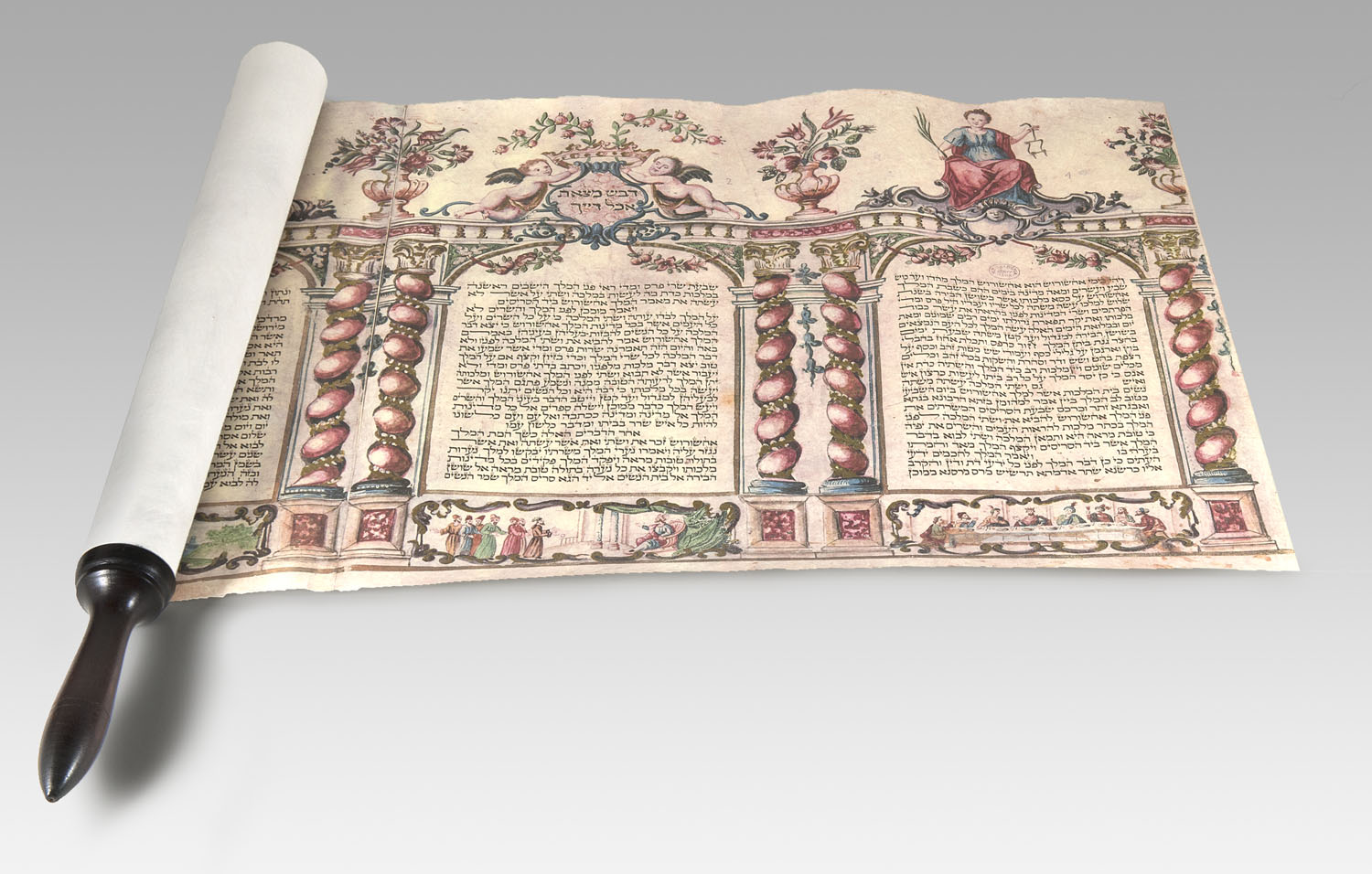
(Das Buch Esther, Megilla) Codex Kaufmann A14. Mit 8 großformatigen allegorischen Figuren u. 16 Vignetten u. zahlr. dekor. floralen u. architektonischen Schmuck. Vollfaksimile mit ungarischem Kommentarband von Irish Fishof. Budapest, Helikon, 1989. Insgesamt 393,5 x 39 cm, sowie mit seperaten Gebetsblatt vom 53 x 39 cm. Holzstab im Pappkarton mit Goldprägung. (Karton an einer Ecke mit kleineren Bestoßung und Defekt).
Judaica
Buchwesen - Faksimileausgaben – Außergewöhnlich dekoratives und kulturhistorisch reizvolles Faksimile einer italienischen Esther-Rolle des 18. Jahrhunderts - eines bedeutenden Objekts jüdischer Buchkunst, hebräischer Kalligraphie und Purim-Liturgie. Die Megillat Esther ("Rolle Esthers") gehört zu den fünf Megillot des Tanach und ist der zentrale biblische Text des jüdischen Purimfestes. Ihre öffentliche Lesung, die Kriat ha-Megillah, zählt zu den wesentlichen Purim-Geboten (Mitzwot) und erfolgt traditionell am Purimabend sowie am folgenden Tag in der Synagoge. Der hebräische Bibeltext erzählt die dramatische Geschichte der jüdischen Königin Esther und ihres Verwandten Mordechai am persischen Hof des Königs Ahasveros: Durch Esthers Mut wird die von Haman geplante Vernichtung der Juden abgewendet. Die Erzählung von Bedrohung, Rettung und Bewahrung der jüdischen Gemeinschaft bildet das religiöse Gedächtnis von Purim und verleiht der Megilla bis heute eine zentrale Stellung in jüdischem Festbrauch, Synagogalkultur und religiöser Volkskunst. Das Faksimile gibt die Vorlage in ihrer reichen, für die italienische Judaica besonders charakteristischen Ausgestaltung wieder. Acht großformatige allegorische Figuren, 16 erzählende Vignetten und ein vielgestaltiger Schmuck aus floralen Ranken, architektonischen Rahmungen und ornamentalen Motiven begleiten die Textkolumnen. Die Bildfolge verbindet biblische Erzählung, jüdische Symbolik und barocke Repräsentationskunst zu einem festlichen Gesamtkunstwerk. Als illuminiertes Zeugnis hebräischer Buch- und Rollenkunst steht die Megilla zugleich in der Tradition repräsentativer jüdischer Handschriften, Synagogenkunst und italienisch-jüdischer Kulturgeschichte. Die Bezeichnung Codex Kaufmann verweist auf den österreichisch-ungarischen jüdischen Gelehrten, Rabbiner und bedeutenden Hebraica-Sammler David Kaufmann (1852-1899). Kaufmann war Professor für jüdische Geschichte, Religionsphilosophie und Homiletik am Budapester Rabbinerseminar und vereinte eine herausragende Bibliothek mit Handschriften und frühen hebräischen Drucken. Nach dem Tod seiner Witwe gelangte seine Sammlung 1905 mit 594 Handschriften und 1.092 gedruckten Werken an die Bibliothek der Ungarischen Akademie der Wissenschaften. Die vorliegende Esther-Rolle gehört somit in den Kontext einer der bedeutendsten europäischen Sammlungen jüdischer Buch- und Geisteskultur. Besonders sammelwürdig als großformatiges Judaicum an der Schnittstelle von Hebraica, Judaica, Purim, Megillat Esther, Tanach, hebräischer Bibel, illuminierter Handschrift, jüdischer Buchkunst, italienischer Judaica, Faksimilekunst und liturgischer Rollenkunst. Ein anschauliches Objekt für Sammler jüdischer Kunst und Kultur, für Bestände zu jüdischen Festen, Synagogen- und Ritualgeschichte, Bibelillustration, hebräischer Schriftkunst und Buchwesen der Diaspora. Die Verbindung aus prachtvollem Bildschmuck, ritueller Bedeutung, großzügigem Format und vollständig beigefügtem Kommentarband macht diese Ausgabe zu einem außergewöhnlich attraktiven Sammlerstück der modernen Faksimile-Editionen.
Books on Books - Facsimile Editions – (The Esther Scroll, The Books of Esther). With 8 big sized allegoric figures, 16 vignettes and numerous dekorative floral and achitectonic decorations. Wooden rod and handle and blue publishers case. (case slightly rubbed and bumped). - An exceptionally decorative and culturally significant facsimile of an eighteenth-century Italian Esther scroll-an important work of Jewish book art, Hebrew calligraphy, and Purim liturgy. The *Megillat Esther* ("Scroll of Esther") is one of the Five Megillot of the Tanakh and the central biblical text of the Jewish festival of Purim. Its public recitation, the *Kriat ha-Megillah*, is among the principal Purim commandments (*mitzvot*) and is traditionally performed in the synagogue on Purim eve and again on the following day. The Hebrew biblical text recounts the dramatic story of the Jewish queen Esther and her relative Mordechai at the Persian court of King Ahasuerus. Through Esther's courage, Haman's planned annihilation of the Jews is averted. This narrative of threat, deliverance, and the preservation of the Jewish community constitutes the religious memory of Purim and has given the Megillah a central place, to this day, in Jewish festival observance, synagogue culture, and religious folk art. The facsimile faithfully reproduces the original in its rich design, particularly characteristic of Italian Judaica. Eight large-scale allegorical figures, sixteen narrative vignettes, and an elaborate decorative scheme of floral scrollwork, architectural frameworks, and ornamental motifs accompany the columns of text. The pictorial programme unites biblical narrative, Jewish symbolism, and Baroque representational art in a festive Gesamtkunstwerk. As an illuminated example of Hebrew manuscript and scroll art, the Megillah also belongs to the tradition of prestigious Jewish manuscripts, synagogue art, and Italian-Jewish cultural history. The designation *Codex Kaufmann* refers to the Austro-Hungarian Jewish scholar, rabbi, and eminent collector of Hebraica, David Kaufmann (1852-1899). Kaufmann was Professor of Jewish History, Religious Philosophy, and Homiletics at the Budapest Rabbinical Seminary, where he assembled an outstanding library of manuscripts and early Hebrew printed books. Following the death of his widow, his collection-comprising 594 manuscripts and 1,092 printed works-entered the Library of the Hungarian Academy of Sciences in 1905. The present Esther scroll thus belongs to the context of one of Europe's most important collections of Jewish book culture and intellectual heritage. Especially desirable as a large-format Judaicum at the intersection of Hebraica, Judaica, Purim, *Megillat Esther*, Tanakh, Hebrew Bible, illuminated manuscripts, Jewish book art, Italian Judaica, facsimile publishing, and liturgical scroll art. A visually compelling object for collectors of Jewish art and culture, as well as for collections devoted to Jewish festivals, synagogue and ritual history, biblical illustration, Hebrew calligraphy, and the book culture of the Jewish diaspora. The combination of sumptuous pictorial decoration, ritual significance, impressive format, and the accompanying scholarly commentary volume makes this edition an exceptionally attractive collector's item among modern facsimile publications.
Startprice: 240 €
Estimate: 360 €
Premium and taxation
This piece is subject to differential taxation. There is a 29,85% buyer's premium on the hammer price. The value added tax is included but not displayable according to §25a UstG.
Shipping
A pickup of this work is possible in our premises at Potsdamer Str. 16, 14163 Berlin by appointment. If you wish a shipment of the work, please contact us for a consultation and shipping calculation. Framed tickets are shipped exclusively by a shipping company due to the risk of breakage. Postal shipping is only carried out at the express request and risk of the buyer.
Terms and Conditions
You can view our terms and conditions here
Droit de Suite
On the sales proceeds of all original works of fine art and photography, whose authors have not yet died 70 years before the end of the sale, an additional 2% (subject to change) of the hammer prices from 400€ will be charged pro rata for the VG Bild-Kunst, which represents the copyrights of visual artists according to § 26 UrhG.
Submit a bid
I would like to participate in your auction by accepting the General Terms and Conditions of Jeschke van Vliet Auctions Berlin GmbH.