Online Catalogue with all Lots / Auction 161
Rare Books, Prints, Historical Photography
Saturday, 24 October 2026
Lose 1 - 1706
Lot 162 Vier Seiten (2 Blätter) aus …
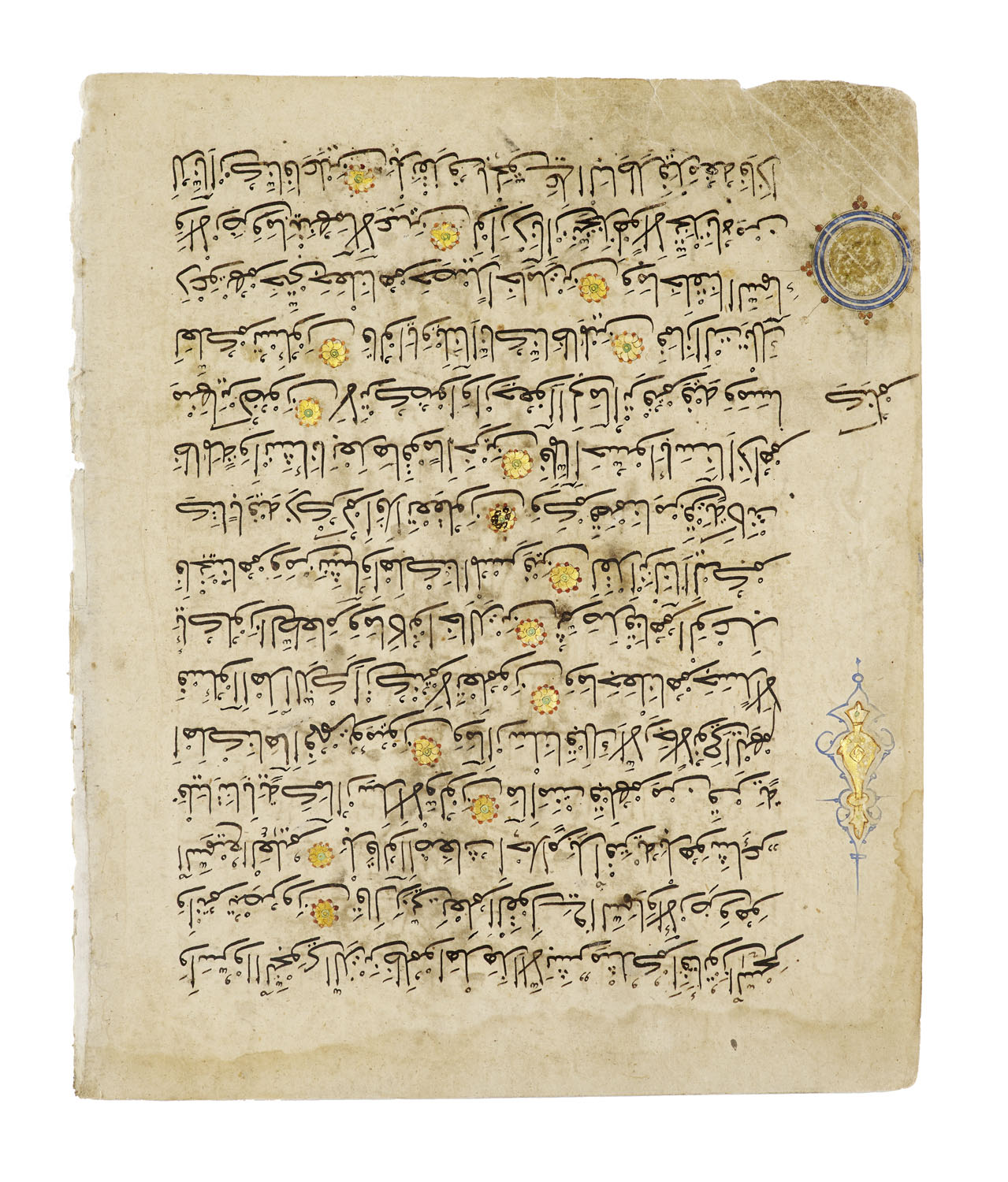
Vier Seiten (2 Blätter) aus einem großformatigen Koran (Mushaf). - 15 Zeilen. Arabisch, Handschrift auf Papier. Wohl Mamlukisches Ägypten oder Syrien, alternativ Iran oder Zentralasien, 1300-1450.
Mittelalter - Arabien
Manuskripte und Urkunden – Zur Austattung: Die Verse sind durch Rosetten in Gold mit roten Punkten und grünem oder blauem Zentrum getrennt. Am Rand stehen blau-goldene Palmettenzeichen mit feinen blauen Linien, die vermutlich Verszählungen oder Abschnitte markieren. Auf zwei Blättern sitzen außerdem runde Randmedaillons mit blauem Doppelring, goldenem Feld und rotem Perlenkranz, wohl Markierungen für größere Abschnitte. - Zur Paläographie: Die Schrift ist eine kräftige, regelmäßige Buchschrift der Naskh-Familie mit Anklängen an Muhaqqaq/Rayan. Charakteristisch sind gerundete Buchstabenkörper, lange gerade Alifs und Lams sowie weit ausgezogene Endformen von Nun, Ya und Ra. Der Text ist in schwarzer Tinte voll vokalisiert. Eine Farbcodierung für Hamza oder Vokale ist nicht erkennbar. Der Duktus ist gleichmäßig und professionell. Die Datierung in das 14. bis 15. Jahrhundert stützt sich auf die Schriftform, das Papier, den Dekor mit Goldrosetten und blau-goldenen Randmarken sowie die Reklamanten. Zum Inhalt: Die vier Blätter bilden zwei aufeinanderfolgende Paare aus zwei weit voneinander entfernten Teilen des Korans. Zum Inhalt: Sure 6 (al-Anam, "Das Vieh"), etwa 6:145-158/159: Der Text beginnt mit der Notfallausnahme für verbotene Speisen, bei der Gott verzeihend und barmherzig ist. Es folgen die Speisevorschriften für die Juden (Krallentragendes, bestimmtes Fett) als Vergeltung für ihre Widerspenstigkeit. Den Leugnern, die ihr Götzendienst mit Gottes Willen rechtfertigen, wird entgegengehalten, dass sie nur Vermutungen folgen. Danach stehen die ethischen Gebote: Gott nichts beigesellen, die Eltern ehren, Kinder nicht aus Armut töten, Schändlichkeiten meiden, nicht unrechtmäßig töten, das Waisengut schützen, Maß und Gewicht gerecht halten und gerecht reden. Es folgen der Hinweis auf den geraden Weg, die Offenbarung an Mose und das gesegnete Buch. Der Abschnitt droht den Leugnern mit dem Tag der Zeichen, an dem später Glaube nichts mehr nützt. Die Reklamante "shian" ("in Parteien") führt weiter. Sure 21 (al-Anbiya, "Die Propheten"), etwa 21:3-31: Die Ungläubigen halten den Propheten für einen Menschen, Zauberer oder Dichter und fordern ein Zeichen. Der Text verweist auf frühere Gesandte, die ebenfalls Menschen waren, und auf zerstörte Städte. Himmel und Erde sind nicht zum Spiel geschaffen, die Wahrheit zerschmettert das Falsche. Gott ist einzig, die Engel preisen ihn unermüdlich, und andere Götter hätten die Welt verdorben. Die Behauptung eines Sohnes wird zurückgewiesen. Die Schöpfungszeichen reichen von der Trennung von Himmel und Erde über das Wasser als Quelle des Lebens bis zu den Bergen und Wegen. Die Reklamante "wa-jaalna s-sama" führt zu 21:32. Beide Passagen verbindet die Einheit Gottes und die Zurückweisung des Götzendienstes. - Teils etwas gebräunt und fleckig, am Rand mit kleinen Defekten, eine Seite mit einem etwas längeren Einriss, ansonsten wohlerhaltenes arabisches Manuskript.
Manuscripts – Medieval - Arabia - Four pages (2 ff.) from a large-format Qur'an (mushaf). 15 lines. Arabic, manuscript on paper. Probably Mamluk Egypt or Syria, alternatively Iran or Central Asia, 1300-1450. Decoration: The verses are separated by gold rosettes with red dots and green or blue centres. In the margins are blue-and-gold palmette marks with fine blue lines, which presumably mark verse counts or sections. Two leaves also carry round marginal medallions with a double blue ring, a gold field and a red beaded border, probably marking larger divisions of the text. Palaeography: The script is a bold, regular book hand of the naskh family, with echoes of muhaqqaq/rayhan. Characteristic features are rounded letter bodies, long straight alifs and lams, and widely extended final forms of nun, ya and ra. The text is fully vocalised in black ink. No colour coding for hamza or vowels is discernible. The ductus is even and professional. The dating to the 14th-15th century rests on the letterforms, the paper, the decoration with gold rosettes and blue-and-gold marginal marks, and the catchwords. Content: The four leaves form two consecutive pairs from two widely separated parts of the Qur'an. Sura 6 (al-An'am, "The Cattle"), approx. 6:145-158/159: The text opens with the exception for cases of necessity regarding forbidden foods, for which God is forgiving and merciful. It continues with the dietary rules for the Jews (animals with claws, certain fats) as recompense for their rebelliousness. The deniers, who justify their idolatry by God's will, are told that they follow only conjecture. Then come the ethical commandments: associate nothing with God, honour one's parents, do not kill children out of poverty, avoid indecencies, do not kill unlawfully, protect the property of orphans, give just measure and weight, and speak justly. The passage goes on to the straight path, the revelation given to Moses, and the blessed Book. The section closes by warning the deniers of the Day of the Signs, on which belief will no longer avail. The catchword "shi'an" ("in factions") leads on to the next page. Sura 21 (al-Anbiya', "The Prophets"), approx. 21:3-31: The disbelievers regard the Prophet as a mere man, a sorcerer or a poet, and demand a sign. The text points to earlier messengers, who were likewise human, and to destroyed cities. Heaven and earth were not created in play, and truth crushes falsehood. God is one, the angels glorify him tirelessly, and other gods would have corrupted the world. The claim that God has a son is rejected. The signs of creation range from the separation of heaven and earth, through water as the source of life, to the mountains and pathways. The catchword "wa-ja'alna s-sama'" leads to 21:32. Both passages share the theme of God's oneness and the rejection of idolatry. Partly slightly discolored and stained, with minor damage along the edges, one page with a somewhat longer tear, otherwise, a well-preserved Arabic manuscript.
Startprice: 1000 €
Estimate: 1500 €
Premium and taxation
This work is subject to under the regular margin scheme. There is a 24.95% buyer's premium on the hammer price and inside the EU 7% (Books, Paintings, Drawings and most Prints) and 19% (Photographs, Screen and Offsetprints, Autographs and Manuscripts) VAT on the final invoice amount.
Shipping
A pickup of this work is possible in our premises at Potsdamer Str. 16, 14163 Berlin by appointment. If you wish a shipment of the work, please contact us for a consultation and shipping calculation. Framed tickets are shipped exclusively by a shipping company due to the risk of breakage. Postal shipping is only carried out at the express request and risk of the buyer.
Terms and Conditions
You can view our terms and conditions here
Droit de Suite
On the sales proceeds of all original works of fine art and photography, whose authors have not yet died 70 years before the end of the sale, an additional 2% (subject to change) of the hammer prices from 400€ will be charged pro rata for the VG Bild-Kunst, which represents the copyrights of visual artists according to § 26 UrhG.
Submit a bid
I would like to participate in your auction by accepting the General Terms and Conditions of Jeschke van Vliet Auctions Berlin GmbH.