Online Catalogue with all Lots / Auction 161
Rare Books, Prints, Historical Photography
Saturday, 24 October 2026
Lose 1 - 1706
Lot 135 Certificat de Calatorie. …
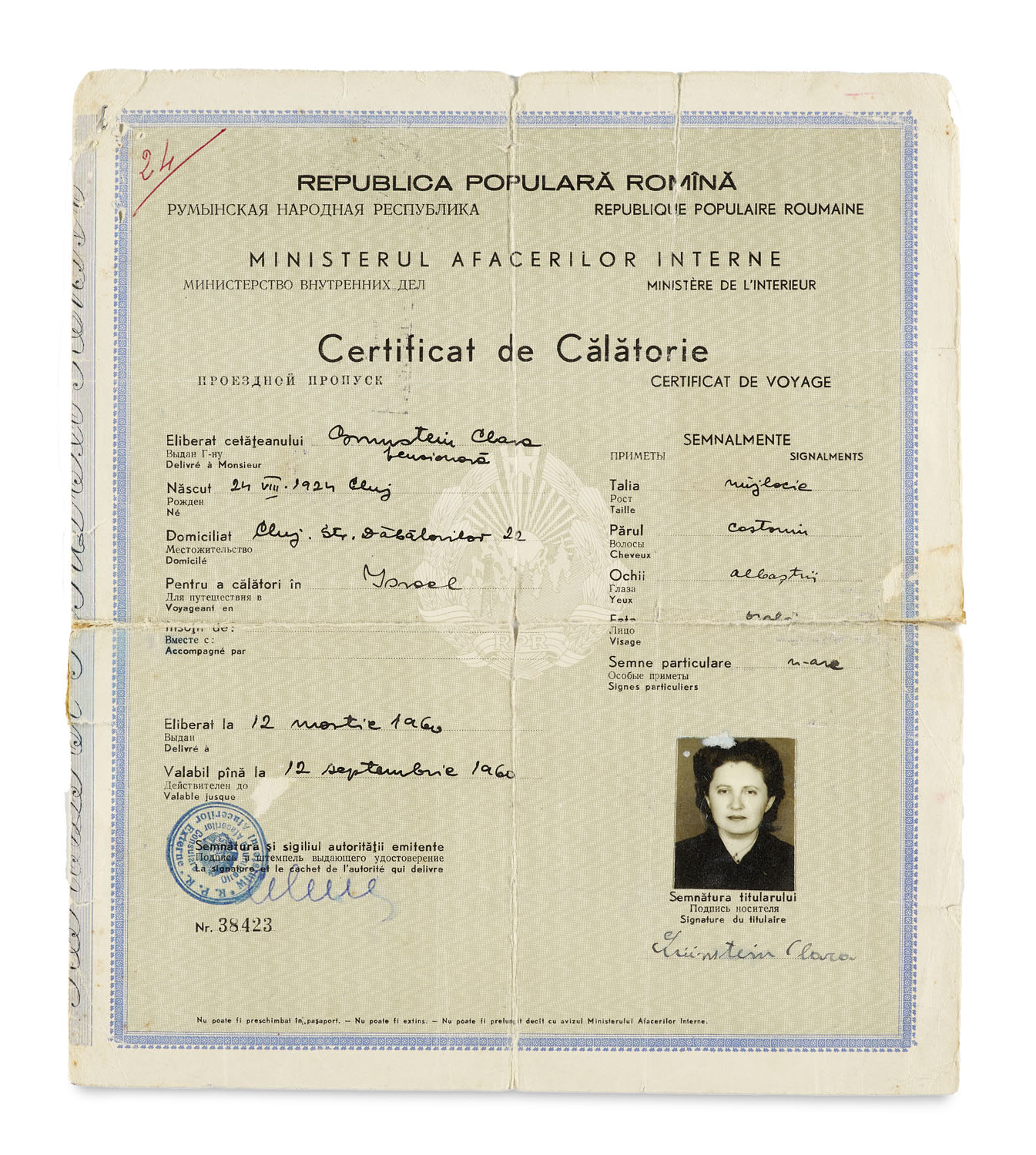
Certificat de Calatorie. (Rumänisches Reisedokument nach Israel.) Bukarest: Ausgestellt vom rumänischen Innenministerium, 1960. Amtliches, gedrucktes Einzelblatt, in Tinte ausgefüllt, mit aufgeklebtem Schwarz-Weiß-Portraitfoto der Inhaberin. Verso mit ausgefüllten und signierten Transitvisa-Stempeln der israelischen (Gesandtschaft).
Judaica
Manuskripte und Urkunden – Nach dem Holocaust lebte in Rumänien mit rund 300.000 Menschen die größte überlebende jüdische Bevölkerung Osteuropas. Mit dem Erstarken des Kommunismus und der Gründung des Staates Israel wuchs unter den Juden des Landes der Wunsch nach Alija, der Auswanderung nach Israel. Die kommunistische Führung wollte sie jedoch nicht kostenlos ziehen lassen. Sie betrachtete die Minderheiten als wertvolle Geiseln, und so begannen Verhandlungen mit Israel über ein Lösegeld. Kurz nach dem Fall des Eisernen Vorhangs nach dem Zweiten Weltkrieg begann Henry Jacober, ein britischer Geschäftsmann jüdischer Herkunft, rumänischen Juden bei der Flucht aus ihrem Land zu helfen. In den frühen 1950er Jahren verlagerte sich das Schleusen auf die offizielle Ebene: Der rumänische Geheimdienst warb Jacober an und er führte geheime Verhandlungen mit Israel, um den jüdischen Staat dazu zu bewegen, für die auswandernden Juden zu zahlen. In einer ersten Phase willigte Gheorghe Gheorghiu-Dej, damals kommunistischer Machthaber Rumäniens, ein, 500 jüdische Familien im Austausch gegen den Bau einer Hühnerfarm ausreisen zu lassen. Bis Mitte der 1960er Jahre finanzierte Israel über Jacober zahlreiche Agrarprojekte in Rumänien: Hühner-, Puten- und Schweinefarmen, automatisierte Schlachthöfe, Lagerhäuser und Verpackungsbetriebe, sogar eine Fabrik für Kellogg's Corn Flakes - jeweils im Austausch gegen jüdische Familien. Zwischen 1958 und 1966 verließen durchschnittlich 14.000 Juden pro Jahr Rumänien. Als Ceau?escu 1965 die Macht übernahm, schränkte er die jüdische Auswanderung ein und kündigte alle bisherigen Abkommen für etwa zwei Jahre. Erst als Israel sich bereit erklärte, pro Person bar zu zahlen, durchschnittlich 4.000 US-Dollar, nahm er sie wieder auf. Das Lösegeld wurde bis zum Fall des Eisernen Vorhangs gezahlt. Rumänische, israelische und amerikanische Geheimdienstquellen stimmen darin überein, dass die Gesamtsumme mehr als 1 Milliarde US-Dollar betrug. Wer das Land verlassen durfte, erhielt ein offizielles Reisedokument wie das vorliegende, ein "Certificat de Calatorie". Die Betroffenen wurden automatisch von Schulen, Universitäten und Arbeitsplätzen verwiesen und als "Feinde des Volkes" gebrandmarkt. Inhaberin des Dokuments ist Emilia Nathan, geboren 1906 in Konstanza (Constan?a), einer rumänischen Hafenstadt am Schwarzen Meer mit einer kleinen jüdischen Gemeinde von etwa 1.500 Personen. Zum Zeitpunkt der Antragstellung lebte sie bereits in Bukarest. Die Stempel der Gesandtschaften im Dokument belegen, dass sie 1965 das Land verließ, zunächst nach Ungarn, dann über Österreich nach Italien. Vermutlich erreichte sie Israel per Fähre über das Mittelmeer. - Zweimal gefaltet, an den Faltungen beschädigt. An den Rändern bestoßen. Insgesamt in ordentlichem Zustand. - Seltenes und bedeutendes historisches Dokument.
Manuscripts – (Romanian Travel Document to Israel.) Bucharest: Issued by the Romanian Ministry of Internal Affairs, 1960. Official printed single sheet, completed in ink, with mounted black-and-white portrait photograph of the holder. Verso with completed and signed transit visa stamps of the Israeli legation. Folded twice, damaged along the folds. Chipped at the extremities. Overall in fair condition. After the Holocaust, Romania had the largest surviving Jewish population in Eastern Europe, numbering about 300,000. As Communism grew stronger and the State of Israel was founded, the wish for aliyah, emigration to Israel, grew among the country's Jews. The Communist leadership, however, was unwilling to let them go for free. It regarded the minorities as valuable hostages, and so negotiations with Israel over a ransom began. Shortly after the Iron Curtain came down following the Second World War, Henry Jacober, a British businessman of Jewish origin, began helping Romanian Jews to escape from their country. In the early 1950s the smuggling moved to an official level: the Romanian secret service recruited Jacober, and he conducted secret negotiations with Israel to persuade the Jewish State to pay for the emigrating Jews. In a first phase, Gheorghe Gheorghiu-Dej, then the Communist ruler of Romania, agreed to allow 500 Jewish families to leave in exchange for the construction of a chicken farm. By the mid-1960s, Israel, working through Jacober, had financed numerous agricultural projects in Romania: chicken, turkey and pig farms, automated slaughterhouses, warehouses and packing plants, and even a factory for Kellogg's Corn Flakes, each in exchange for Jewish families. Between 1958 and 1966, an average of 14,000 Jews left Romania each year. When Ceaucescu took power in 1965, he restricted Jewish emigration and cancelled all previous agreements for about two years. He resumed them only when Israel agreed to pay cash per person, at an average of US$4,000. The ransom continued to be paid until the fall of the Iron Curtain. Romanian, Israeli and American intelligence sources agree that the total exceeded US$1 billion. Those permitted to leave the country received an official travel document such as the present one, a "Certificat de Calatorie". They were automatically expelled from schools, universities and workplaces and branded "enemies of the people". The holder of the document was Emilia Nathan, born in 1906 in Constan?a, a Romanian port city on the Black Sea with a small Jewish community of about 1,500 people. At the time of her application she was already living in Bucharest. The legation stamps in the document show that she left the country in 1965, first for Hungary, then via Austria to Italy. She presumably reached Israel by ferry across the Mediterranean.
Startprice: 800 €
Estimate: 1200 €
Premium and taxation
This work is subject to under the regular margin scheme. There is a 24.95% buyer's premium on the hammer price and inside the EU 7% (Books, Paintings, Drawings and most Prints) and 19% (Photographs, Screen and Offsetprints, Autographs and Manuscripts) VAT on the final invoice amount.
Shipping
A pickup of this work is possible in our premises at Potsdamer Str. 16, 14163 Berlin by appointment. If you wish a shipment of the work, please contact us for a consultation and shipping calculation. Framed tickets are shipped exclusively by a shipping company due to the risk of breakage. Postal shipping is only carried out at the express request and risk of the buyer.
Terms and Conditions
You can view our terms and conditions here
Droit de Suite
On the sales proceeds of all original works of fine art and photography, whose authors have not yet died 70 years before the end of the sale, an additional 2% (subject to change) of the hammer prices from 400€ will be charged pro rata for the VG Bild-Kunst, which represents the copyrights of visual artists according to § 26 UrhG.
Submit a bid
I would like to participate in your auction by accepting the General Terms and Conditions of Jeschke van Vliet Auctions Berlin GmbH.