Online Catalogue with all Lots / Auction 159
From noble estates and bourgeois property.
Rare Books, Prints, and Classical art
Saturday, 25 April 2026 at 10:00 am - After sale
Lot 35 Johannes (i.e. Joh. Müller von Königsberg) Regiomontanus. Kalendarius teütsch. Mit …
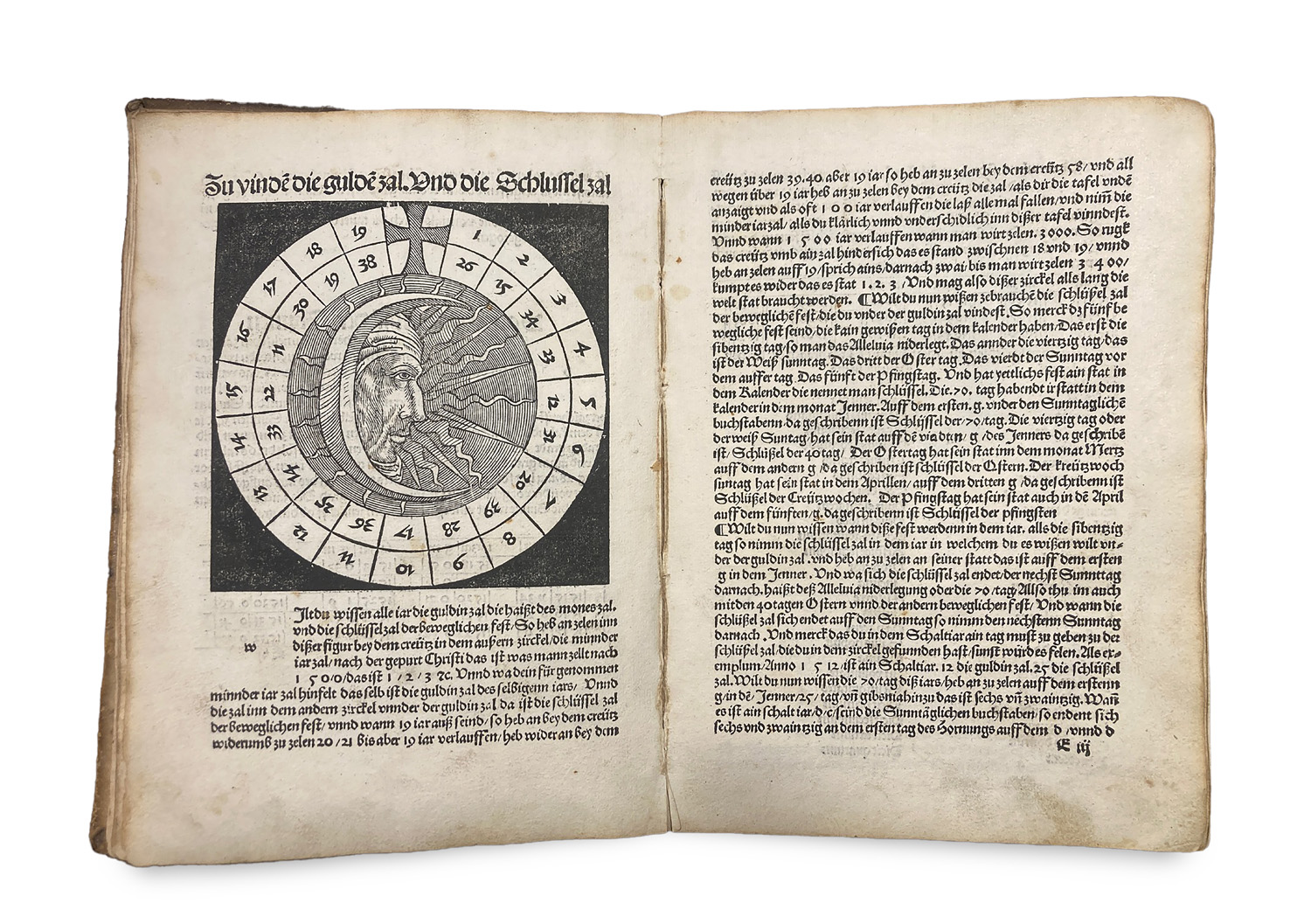
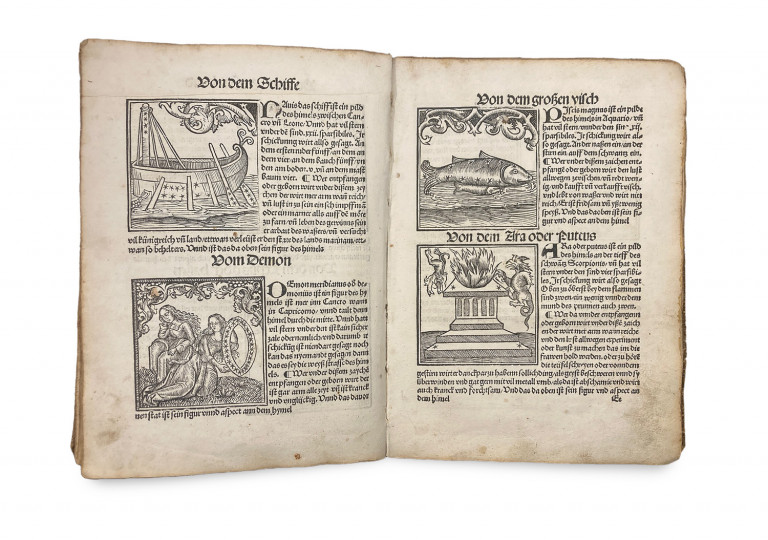
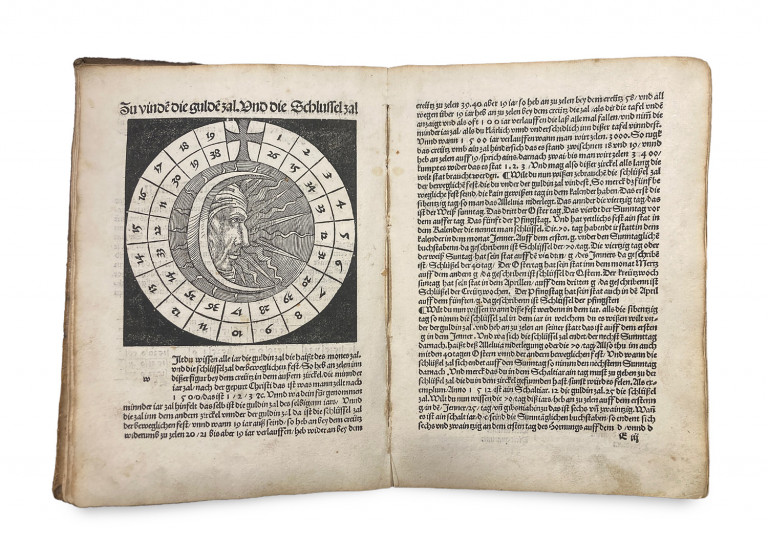
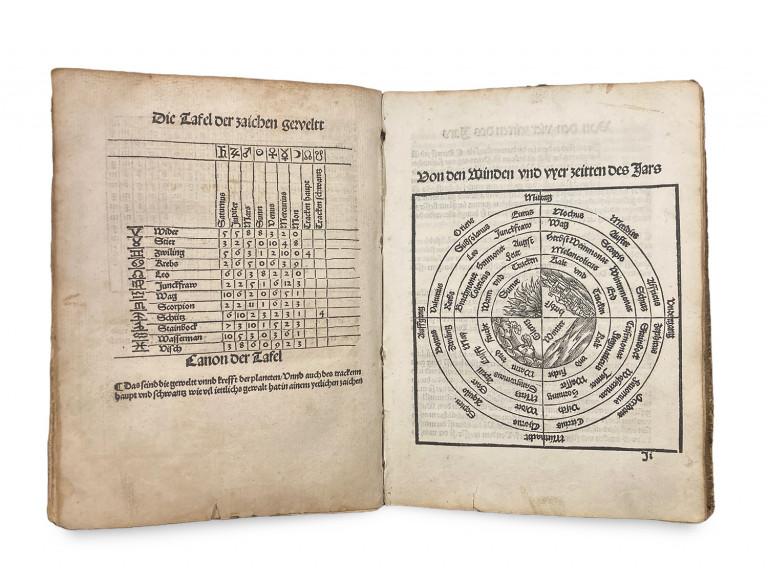
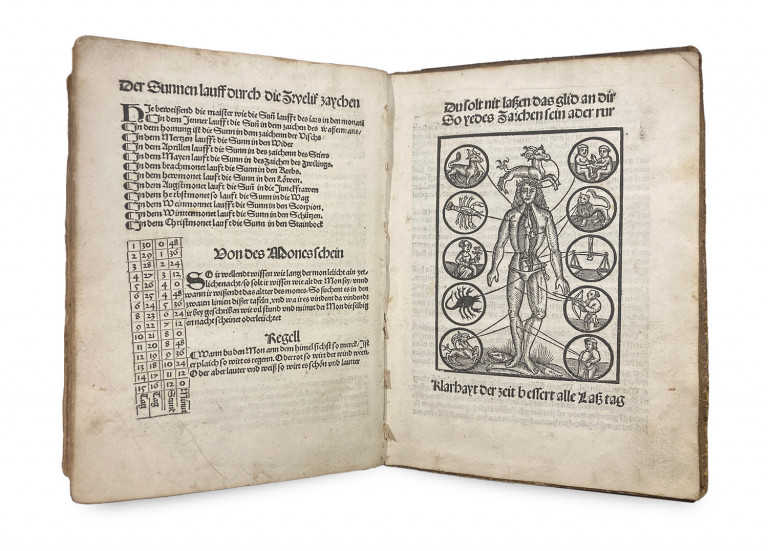
Kalendarius teütsch. Mit vierteiliger Metallschnitt-Titelbordüre, 1 großen schwarzgrundigen Holzschnitt-Initiale, 12 kleinen KL-Initialen in Metallschnitt sowie 92 Textholzschnitten, davon 10 große und 1 mit beweglichen Teilen. Augsburg, Syttich, 1512. 76 nn. Bll. Schweinsldr. d. Zt. (berieben, angestaubt, tls. fleckig, Bindebänder fehlen, Deckel leicht aufgebogen).
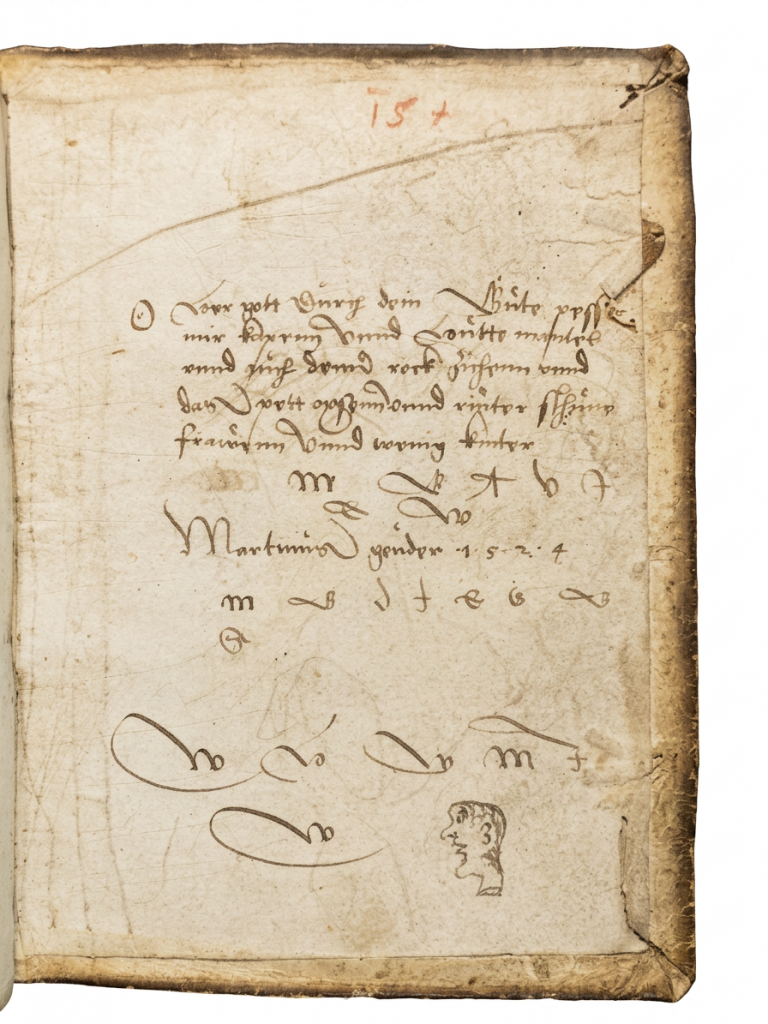
Alte Drucke, Bibeln, Klassische Autoren in den Originalsprachen – VD 16, M 6539. - Adams R 285. - Houzeau/Lanc. 14452. - Zinner, Astr. Lit. 966. - Zweite Ausgabe, (erschien erstmals 1508 in Zürich.) - Kein Exemplar im internationalen Handel für uns nachweisbar. Von größter Seltenheit. - Im Vor- und Nachsatz mit Marginalien, einer kleinen Handzeichnung und handschriftlichem Exlibris des Nürnberger Patriziers Martin Geuder III. (1455-1532). Er entstammte der Nürnberger Patrizierfamilie Geuder von Heroldsberg und war über Jahrzehnte Mitglied des Inneren Rates sowie Reichsschultheiß und Vorderster Losunger der Reichsstadt Nürnberg. Er ließ 1489 in Heroldsberg das repräsentative Rote Schloss erbauen, das den Anspruch und Reichtum seiner Familie demonstrierte. Durch seine Ehe mit Juliana Pirckheimer war er Schwager des Humanisten Willibald Pirckheimer und damit eng in das humanistisch-kulturelle Netzwerk Nürnbergs eingebunden. Über diesen Kreis lernte er Albrecht Dürer kennen, zu dem sich ein freundschaftliches Verhältnis entwickelte. Dürer hielt sich mehrfach in Heroldsberg auf und schuf dort 1510 die berühmte Zeichnung "Das Kirchdorf", die als älteste Darstellung Heroldsbergs und zugleich als Zeugnis der Freundschaft zwischen Künstler und Patrizier gilt.- Der seltene Druck ist ein volkssprachiger, in Frühneuhochdeutsch abgefasster astronomisch-astrologischer Kalenderdruck, der die im 15. Jahrhundert von Johannes Regiomontanus entwickelte Kalendertradition in die frühneuzeitliche Druckkultur der Reichsstadt Augsburg überführt. Unter dem Namen "Maister Joannis Küngspergers" firmierend, vermittelt das Werk in kompakter, durch Tabellen und Holzschnitte gegliederter Form grundlegende Kenntnisse der praktischen Astronomie - insbesondere zur Berechnung von Sonnenlauf, Mondphasen, Finsternissen und Festtagen - und verbindet diese systematisch mit zeittypischen astrologischen Deutungsmustern. Die Holzschnitt-Illustrationen zeigen die Tierkreiszeichen und ihre Zuordnungen zu den menschlichen Organen, Planetenbahnen, Anleitungen zum Aderlassen u. a. In inhaltlicher Hinsicht lässt sich der Druck als Schnittstelle zwischen spätmittelalterlicher Mantik und aufkommender mathematischer Astronomie beschreiben: Er integriert einerseits die scholastisch geprägte Praxis der Auswahl günstiger Tage für medizinische Eingriffe, Reisen oder landwirtschaftliche Tätigkeiten, andererseits reflektiert er bereits das stärkere Gewicht numerischer Tabellen und Rechenverfahren, wie sie für die humanistische Astronomie der frühen Neuzeit charakteristisch sind. Innerhalb der Druckproduktion des Augsburger Buchdruckers Johann Sittich nimmt das Werk eine hervorgehobene Stellung ein, da die Offizin nur durch wenige, heute bibliographisch gesicherte Drucke der Jahre um 1512 belegt ist und der Kalender zu den am besten dokumentierten und reichsten Ausstattungsstücken gehört. - Innenfalz angeplatzt u. Folgeblätter tls. gelöst bzw. gelockert, Volvellen und dazugehöriges Blatt teils neu ergänzt, teils etwas (finger-) fleckig, einige Blätter mit Randläsuren, insgesamt gutes Exemplar des seltenen Druckes.
Prints before 1600, Bibles, Classics in Original Languages – Featuring a four-part metal-engraved title border, 1 large woodcut initial on a black background, 12 small KL initials in metal engraving, and 92 woodcut illustrations, including 10 large ones and 1 with moving parts. The woodcut illustrations depict the signs of the zodiac and their correspondences to human organs, planetary orbits, instructions for bloodletting, and more. In the front and back matter there are marginal notes, a small hand drawing, and handwritten ex-libris entries by Martin Geuder III (1455-1532). He came from the Nuremberg patrician family Geuder von Heroldsberg and for decades was a member of the Inner Council as well as imperial bailiff (Reichsschultheiß) and chief treasurer (Vorderster Losunger) of the imperial city of Nuremberg. In 1489 he had the representative Red Castle in Heroldsberg built, which demonstrated his family's ambitions and wealth. Through his marriage to Juliana Pirckheimer he was the brother-in-law of the humanist Willibald Pirckheimer and thus closely connected to Nuremberg's humanist and cultural network. Dürer stayed several times in Heroldsberg and produced there in 1510 the famous drawing "The Village," which is considered the earliest depiction of Heroldsberg and at the same time a testament to the friendship between artist and patrician. - The rare print is a vernacular astronomical-astrological calendar in Early New High German that transfers the calendar tradition developed in the 15th century by Johannes Regiomontanus into the early modern print culture of the imperial city of Augsburg. Appearing under the name "Maister Joannis Küngspergers," the work conveys, in a compact form structured by tables and woodcuts, fundamental knowledge of practical astronomy-above all for calculating the course of the sun, the phases of the moon, eclipses, and feast days-and systematically combines this with contemporary astrological patterns of interpretation. In terms of content, the print can be described as a point of transition between late medieval mantic practice and the emerging mathematical astronomy: on the one hand it integrates the scholastic practice of choosing auspicious days for medical procedures, travel, or agricultural work, while on the other it already reflects the greater importance of numerical tables and computational methods characteristic of humanist astronomy in the early modern period. Within the printed output of the Augsburg printer Johann Sittich, the Kalendarius teütsch occupies a prominent place, since the press is documented by only a few securely attested editions from around 1512, and the calendar ranks among the best documented and most richly furnished of these productions.
Result: 3300 €
Premium and taxation
This work is subject to under the regular margin scheme. There is a 24.95% buyer's premium on the hammer price and inside the EU 7% (Books, Paintings, Drawings and most Prints) and 19% (Photographs, Screen and Offsetprints, Autographs and Manuscripts) VAT on the final invoice amount.
Shipping
A pickup of this work is possible in our premises at Potsdamer Str. 16, 14163 Berlin by appointment. If you wish a shipment of the work, please contact us for a consultation and shipping calculation. Framed tickets are shipped exclusively by a shipping company due to the risk of breakage. Postal shipping is only carried out at the express request and risk of the buyer.
Terms and Conditions
You can view our terms and conditions here
Droit de Suite
On the sales proceeds of all original works of fine art and photography, whose authors have not yet died 70 years before the end of the sale, an additional 2% (subject to change) of the hammer prices from 400€ will be charged pro rata for the VG Bild-Kunst, which represents the copyrights of visual artists according to § 26 UrhG.
Submit a bid
I would like to participate in your auction by accepting the General Terms and Conditions of Jeschke van Vliet Auctions Berlin GmbH.