Online Catalogue with all Lots / Auction 162
Moderne und Zeitgenössische Kunst
Saturday, 12 December 2026
Lot 258 Wassily Kandinsky. Kleine Welten X. 1922. …
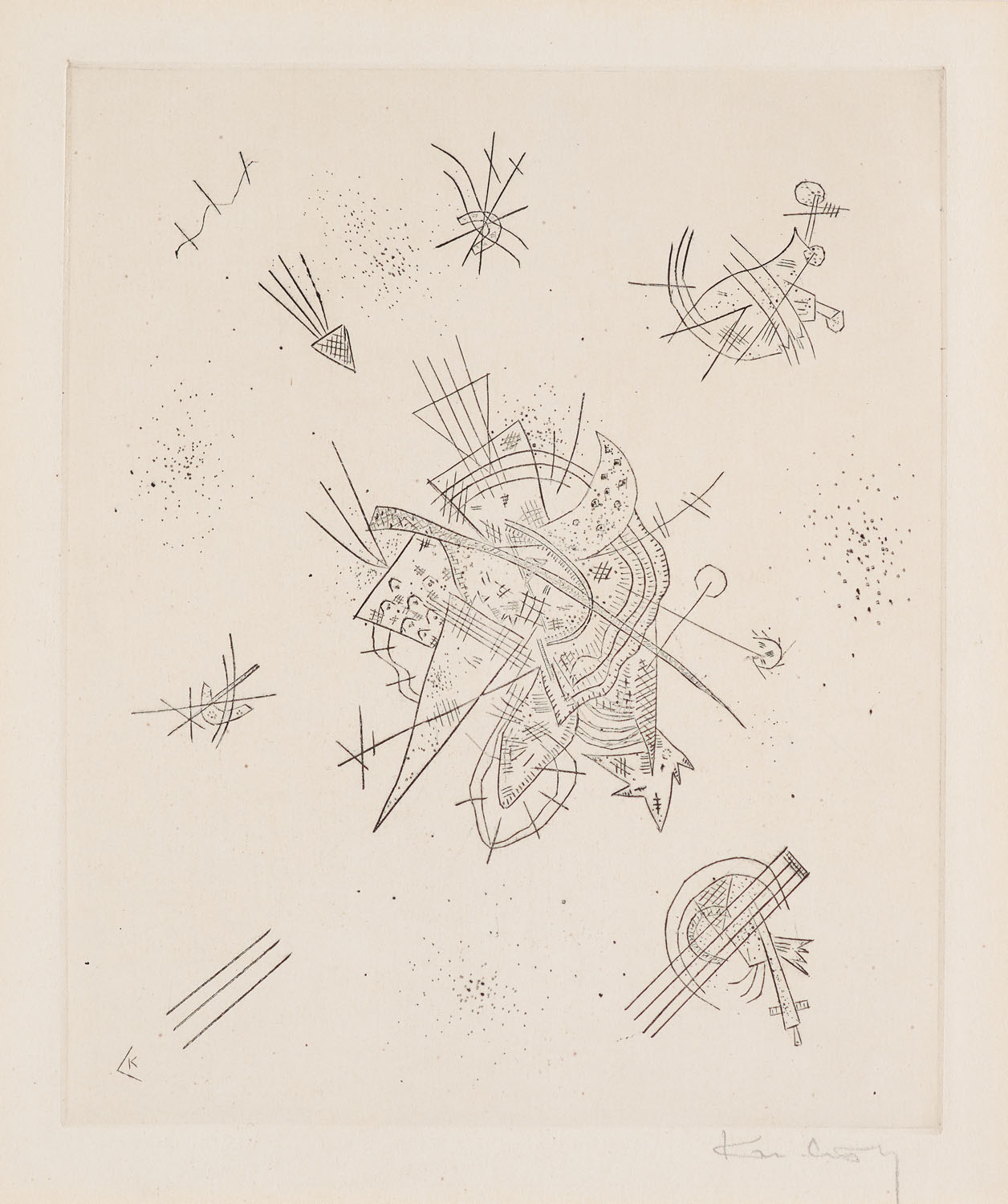
Kleine Welten X. 1922. Kaltnadel auf Velin. 23,8 x 19,9 cm (30 x 27 cm). Signiert, in der Platte monogrammiert. Punktuell auf Passepartoutrückseite montiert. - In Rändern bis an den Passepartoutausschnitt leicht gebräunt, stellenweise winzige Braunflecken, im oberen linken Rand kleiner Oberflächeneinriss am Papier, in oberer linker Ecke wenige sehr oberflächliche und kaum wahrnehmbare Kratzspuren, im oberen rechten und den seitlichen Rändern sehr wenige, sehr leichte Quetschfalten, Papier in beiden oberen seitlichen Außenrändern ganz leicht berieben, verso leicht gebräunt, mit winzigen Braunflecken, in Rändern mit schmalen Montierungsstreifen, ebd. Papier tls. leicht berieben bzw. mit Kleberückstand, tls. vereinzelter blasser Braunfleck, insgesamt gut. Ganz hervorragender, klar konturierter Druck mit deutlich eingeprägter Plattenkante und deutlich zeichnender Facette, mit Rand.
Klassische Moderne – Roethel 173. - Eines von 200 Exemplaren. - Druck Staatliches Bauhaus Weimar. - Hrsg. v. Propyläen Verlag Berlin. - Blatt 10 der berühmten, 12-teiligen Folge "Kandinsky, Kleine Welten". - Die Folge "Kleine Welten" von Wassily Kandinsky entsteht kurz nach seiner Rückkehr aus Moskau nach Deutschland, im Juni 1922 beruft ihn Walter Gropius als Professor an das legendäre Staatliche Bauhaus in Weimar. Er schließt sich Paul Klee an, leitet die Werkstatt für Wandmalerei sowie einen Teil der Grundausbildung. In Auseinandersetzung mit dem Konstruktivismus und den sachlichen und funktionalen Grundsätzen des Bauhaus, wendet sich Kandinsky Anfang der 1920er Jahre zunehmend von den frei fließenden Linien und Formen seiner frühen Arbeiten einer geometrischen Form der Abstraktion zu. Den Konstruktions- und Formenprinzipien stellt er eine spontane, intuitive Gestaltungssprache entgegen. Zu seinen ersten künstlerischen Arbeiten am Bauhaus zählt das berühmte Mappenwerk "Kleine Welten", das eine Folge von 12 Druckgraphiken darstellt. Galka Scheyer schreibt er: "Alle Platten und Steine habe ich eigenhändig gemacht, alle Abzüge wurden unter meiner ständigen Leitung gedruckt ... die ganze Ausführung erstklassig." Im Vorwort des Mappenwerks heißt es ferner: "Die 'Kleinen Welten' klingen aus 12 Blättern heraus. 4 dieser Blätter sind mit Hilfe des Steins entstanden, 4 - des Holzes, 4 - des Kupfers. Drei Gruppenarten. Jede Art wurde nach der ihr geeigneten Eigenschaft gewählt. Die Eigenschaft jeder Art verhalf dem äußeren Wesen der Gestaltung 4 verschiedener 'Kleiner Welten'. In 6 Fällen begnügten sich die 'Kleinen Welten' mit schwarzem Strich oder schwarzem Fleck. Die 6 anderen brauchten den Klang auch anderer Farben. In allen 12 Fällen bekamen die 'Kleinen Welten' im Strich und Fleck die ihnen notwendige Sprache." Die drei verwendeten Drucktechniken bergen jede für sich unterschiedliche Eigenschaften, die Kandinsky in seiner Schrift "Punkt und Linie zu Fläche" von 1928 niederlegt. Die Kaltnadel erzeugt scharfe, präzise Linien, während der Holzschnitt eine reiche Textur und Tiefe wiedergibt und die Lithographie der Malerei am nächsten kommt. Den Techniken werden zudem soziale Komponenten beigemessen, die Radierung sei "aristokratischer" Natur, der Holzschnitt "handwerklich", die Lithographie "demokratisch". In den "Kleinen Welten" gehen Material, Zahl und Klang eine Einheit ein. Der auf dem Papier geschaffene Mikrokosmos, die kleine Welt, spricht gefühlsmäßig Empfindungen an. Zu den Abstrakten Linie und Punkt gesellen sich amorphe, an Gegenständliches erinnernde Formen und Wesen, die je sechsmal schwarz-weiß und sechsmal farbig zur kosmischen Dimension der Zahl zwölf werden. Allen Blättern gemeinsam sind eine verhaltene Zentrierung, kreuzende Diagonalen und abstrakte geometrische Formen wie Dreieck, Kreis, Quadrat, die mit Strichen und Reminiszenzen an die Dingwelt korrespondieren. Jedes Blatt "klingt" in seiner eigenen Art und kulminiert mit den anderen der Folge zu einem musikalischen Gesamtensemble.
Classical Modernism – Drypoint on wove paper. Signed, monogrammed in the plate. Spot-mounted to mat's back. - Slightly browned in margins up to mat section, tiny brown stains in spots, small superficial tear in upper left margin, few very superficial and hardly visible scratch marks in upper letf corner, very few, very slight pinch pleats in upper right and side margins, paper very slightly rubebd in both upper side margins, verso slightly browned, tiny brown stains, narrow traces of mounting in margins, tehre paper partly slightly rubbed or rather with traces from glue, partly isolated faint brown stains, all in all good. Very excellent, clearly contoured impression with clearly impressed plate mark and clearly drawn facet, with margin, - One of 200 copies. - Print by Staatliches Bauhaus Weimar. - Publ. bx Propyläen Verlag Berlin. - Work 10 from the 12-parted portfolio "Kandinsky, Kleine Welten." - Wassily Kandinsky's series 'Small Worlds' was created shortly after his return to Germany from Moscow; in June 1922, Walter Gropius appointed him as a professor at the legendary State Bauhaus in Weimar. He joined Paul Klee, heading the workshop for mural painting as well as part of the basic training programme. Engaging with Constructivism and the objective and functional principles of the Bauhaus, Kandinsky increasingly turned away from the free-flowing lines and forms of his early works towards a geometric form of abstraction in the early 1920s. He contrasted these principles of construction and form with a spontaneous, intuitive artistic language. Among his earliest artistic works at the Bauhaus was the famous portfolio 'Kleine Welten' ('Small Worlds'), comprising a series of 12 prints. Each of the three printmaking techniques used has its own distinct characteristics, which Kandinsky sets out in his 1928 essay 'Point and Line to Plane'. Drypoint produces sharp, precise lines, whilst woodcut conveys a rich texture and depth, and lithography comes closest to painting. Social connotations are also attributed to these techniques: etching is said to be 'aristocratic' in nature, woodcut 'artisanal', and lithography 'democratic'. In the "Small Worlds", material, number and sound form a unity. The microcosm created on paper - the small world - appeals to the emotions. Abstract lines and dots are joined by amorphous forms and creatures reminiscent of the figurative world, which, appearing six times in black and white and six times in colour, take on the cosmic dimension of the number twelve. Common to all the sheets are a restrained centralisation, intersecting diagonals and abstract geometric shapes such as triangles, circles and squares, which correspond with lines and echoes of the physical world. Each sheet 'resonates' in its own way and, together with the others in the series, culminates in a musical ensemble as a whole.
Startprice: 3000 €
Estimate: 4000 €
Premium and taxation
This piece is subject to differential taxation. There is a 29,85% buyer's premium on the hammer price. The value added tax is included but not displayable according to §25a UstG.
Shipping
A pickup of this work is possible in our premises at Potsdamer Str. 16, 14163 Berlin by appointment. If you wish a shipment of the work, please contact us for a consultation and shipping calculation. Framed tickets are shipped exclusively by a shipping company due to the risk of breakage. Postal shipping is only carried out at the express request and risk of the buyer.
Terms and Conditions
You can view our terms and conditions here
Droit de Suite
On the sales proceeds of all original works of fine art and photography, whose authors have not yet died 70 years before the end of the sale, an additional 2% (subject to change) of the hammer prices from 400€ will be charged pro rata for the VG Bild-Kunst, which represents the copyrights of visual artists according to § 26 UrhG.
Submit a bid
I would like to participate in your auction by accepting the General Terms and Conditions of Jeschke Jádi Auctions Berlin GmbH.