Online Catalogue with all Lots / Auction 162
Moderne und Zeitgenössische Kunst
Saturday, 12 December 2026
Lot 230 Conrad Kiesel (Nach). Junge Frau mit Chrysanthemen …

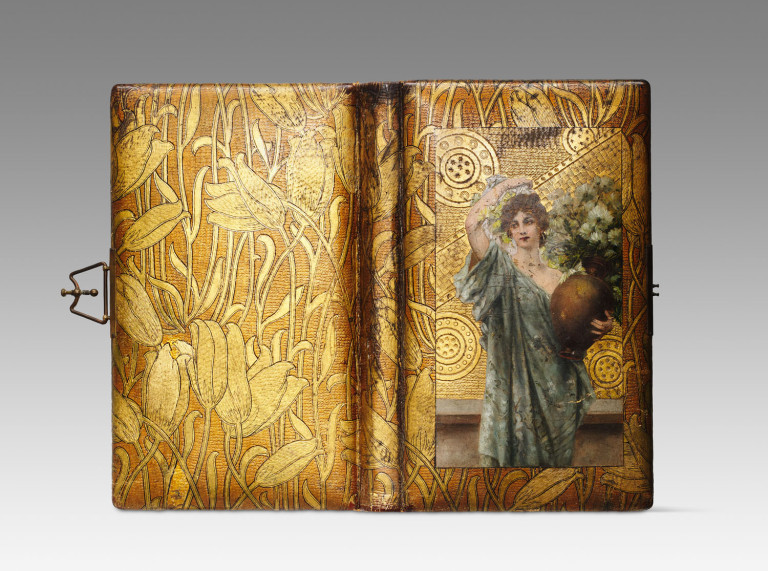
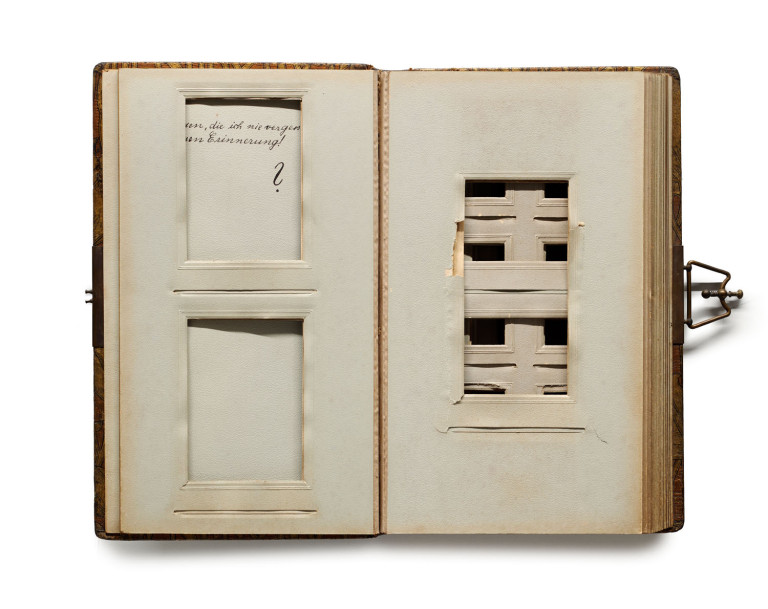
Junge Frau mit Chrysanthemen in einer Amphore. Um 1895/1900. Öl auf Leder auf einem Vorderdeckel eines Photoalbums. 30,6 x 17 cm (39,6 x 22,6 cm). Einband mit geprägtem und vergoldetem Jugendstildekor aus stilisierten Tulpen- und Lilienblüten, im Bildfeld geprägter Goldgrund mit Kreisscheiben, Flechtband- und Wellenmustern. Gepolsterter Deckel mit gerundeten Ecken, Metallschließe an der rechten Kante. - Netzartiges Alterscraquelé über die gesamte Figur, besonders im Gewand und im Inkarnat. Kleinere Farbverluste an Stirn, Wange, Hals, Dekolleté und erhobenem Arm, an denen ein heller Grund sichtbar wird. Weitere Fehlstellen im Gewand auf Hüfthöhe zeigen einen goldfarbenen Untergrund. - Insgesamt gut erhalten.
Skulptur - Jugendstil
Jahrhundertwende – Vor einem Goldgrund steht eine junge Frau in einem weit fallenden, antikisierenden Gewand aus graublauer Seide. Den rechten Arm hat sie über den Kopf gehoben und hält damit einen weißen Schleier im dunklen Lockenhaar, in das ein Kranz aus gelben Blüten geflochten ist. Mit der linken Hand stützt sie eine bauchige Amphore aus Bronze oder Ton, aus der ein üppiger Strauß weißer Chrysanthemen aufsteigt. Ihr Blick ist mit leicht gesenkten Lidern ernst auf den Betrachter gerichtet. Eine steinerne Brüstung im unteren Bilddrittel schließt den flachen Bildraum ab. Bildtypus und Ausstattung folgen der Berliner Salonmalerei der Kaiserzeit, die keiner so prägte wie Conrad Kiesel (1846-1921). Kiesel war ursprünglich Bildhauer und wurde an der Düsseldorfer Akademie bei Wilhelm Sohn zum Maler ausgebildet. Mit idealisierten Bildern junger Frauen wurde er zum erfolgreichsten Porträt- und Salonmaler Berlins. Besonders eng ist die Verwandtschaft mit seiner um 1900 entstandenen "Blumengabe". Auch dort erscheint eine dunkelhaarige junge Frau mit Lorbeerkranz in einem antikisierenden graublauen Gewand vor gelblichem Goldgrund, und Chrysanthemen sind das zentrale Blumenmotiv. Das Gewand umschließt die Figur dort ebenfalls wie ein Blütenkelch. Kiesel selbst hatte dieses Motiv aus seinem Bild "Die Margareten" (Manchester Art Gallery) entwickelt, das auch die KPM Berlin auf Porzellan übertrug. Der Albumdeckel zeigt, wie weit Kiesels Bildideen über das Tafelbild hinaus wirkten. Seine Kompositionen erschienen in Illustrierten wie "Moderne Kunst" und auf Porzellanplatten der KPM. Das vorliegende Deckelbild ist eigenständig in Öl gemalt. Der Pinselduktus ist vor allem in den pastos aufgesetzten Chrysanthemen und in den Faltenzügen des Gewands gut zu erkennen. Am Gesicht zeigt sich die Qualität des Malers: Er modelliert es weich und gibt ihm einen ernsten, verhaltenen Ausdruck. Es ist ein reizvolles Zeugnis dafür, wie die akademische Salonmalerei um 1900 in das Kunsthandwerk und die bürgerliche Wohnkultur einging. Es verbindet die Bildwelt der Berliner Salonmalerei mit der Ornamentik des frühen Jugendstils.
Fin de Siecle – Young woman with chrysanthemums in an amphora. Circa 1895/1900. Oil on leather on the front cover of a photograph album. 30.6 x 17 cm (39.6 x 22.6 cm). Binding with embossed and gilt Art Nouveau decoration of stylized tulip and lily blossoms; the pictorial field has an embossed gold ground with circular discs, interlace bands and wave patterns. Padded cover with rounded corners, metal clasp on the right edge. - Network of age craquelure across the entire figure, especially in the drapery and flesh tones. Minor paint losses at the forehead, cheek, neck, décolleté and raised arm, revealing a light ground. Further losses in the drapery at hip level reveal a gold-colored underlayer. - Overall in good condition. Against a gold ground stands a young woman in a loosely falling, antique-style gown of grey-blue silk. She has raised her right arm above her head, holding a white veil in her dark curly hair, into which a wreath of yellow blossoms is woven. With her left hand she steadies a bulbous amphora of bronze or clay, from which a lush bouquet of white chrysanthemums rises. Her gaze, with slightly lowered eyelids, meets the viewer with a serious expression. A stone parapet in the lower third of the picture closes off the shallow pictorial space. The pictorial type and its appointments follow the Berlin salon painting of the Wilhelmine era, which no one shaped more than Conrad Kiesel (1846-1921). Kiesel was originally a sculptor and trained as a painter at the Düsseldorf Academy under Wilhelm Sohn. With his idealized images of young women, he became the most successful portrait and salon painter in Berlin. The closest affinity is with his "Blumengabe" ("Gift of Flowers"), painted around 1900. There, too, a dark-haired young woman with a laurel wreath appears in an antique-style grey-blue gown against a yellowish gold ground, and chrysanthemums are the central floral motif. Here as well, the gown encloses the figure like the calyx of a flower. Kiesel himself had developed this motif from his painting "Die Margareten" (Manchester Art Gallery), which the KPM Berlin also transferred onto porcelain. The album cover demonstrates how far Kiesel's pictorial ideas reached beyond the easel painting. His compositions appeared in illustrated periodicals such as "Moderne Kunst" and on KPM porcelain plaques. The present cover painting is an independent work in oil. The brushwork is especially visible in the impasto chrysanthemums and in the folds of the gown. The quality of the painter shows in the face, which he models softly and endows with a serious, restrained expression. It is a charming testimony to how academic salon painting around 1900 entered the decorative arts and bourgeois domestic culture, combining the imagery of Berlin salon painting with the ornament of early Art Nouveau.
Startprice: 600 €
Estimate: 800 €
Premium and taxation
This piece is subject to differential taxation. There is a 29,85% buyer's premium on the hammer price. The value added tax is included but not displayable according to §25a UstG.
Shipping
A pickup of this work is possible in our premises at Potsdamer Str. 16, 14163 Berlin by appointment. If you wish a shipment of the work, please contact us for a consultation and shipping calculation. Framed tickets are shipped exclusively by a shipping company due to the risk of breakage. Postal shipping is only carried out at the express request and risk of the buyer.
Terms and Conditions
You can view our terms and conditions here
Droit de Suite
On the sales proceeds of all original works of fine art and photography, whose authors have not yet died 70 years before the end of the sale, an additional 2% (subject to change) of the hammer prices from 400€ will be charged pro rata for the VG Bild-Kunst, which represents the copyrights of visual artists according to § 26 UrhG.
Submit a bid
I would like to participate in your auction by accepting the General Terms and Conditions of Jeschke Jádi Auctions Berlin GmbH.