Online Catalogue with all Lots / Auction 161
Rare Books, Prints, Historical Photography
Saturday, 24 October 2026
Lose 1 - 1706 - After sale
Lot 816 Silhouetten-Album mit 126 …
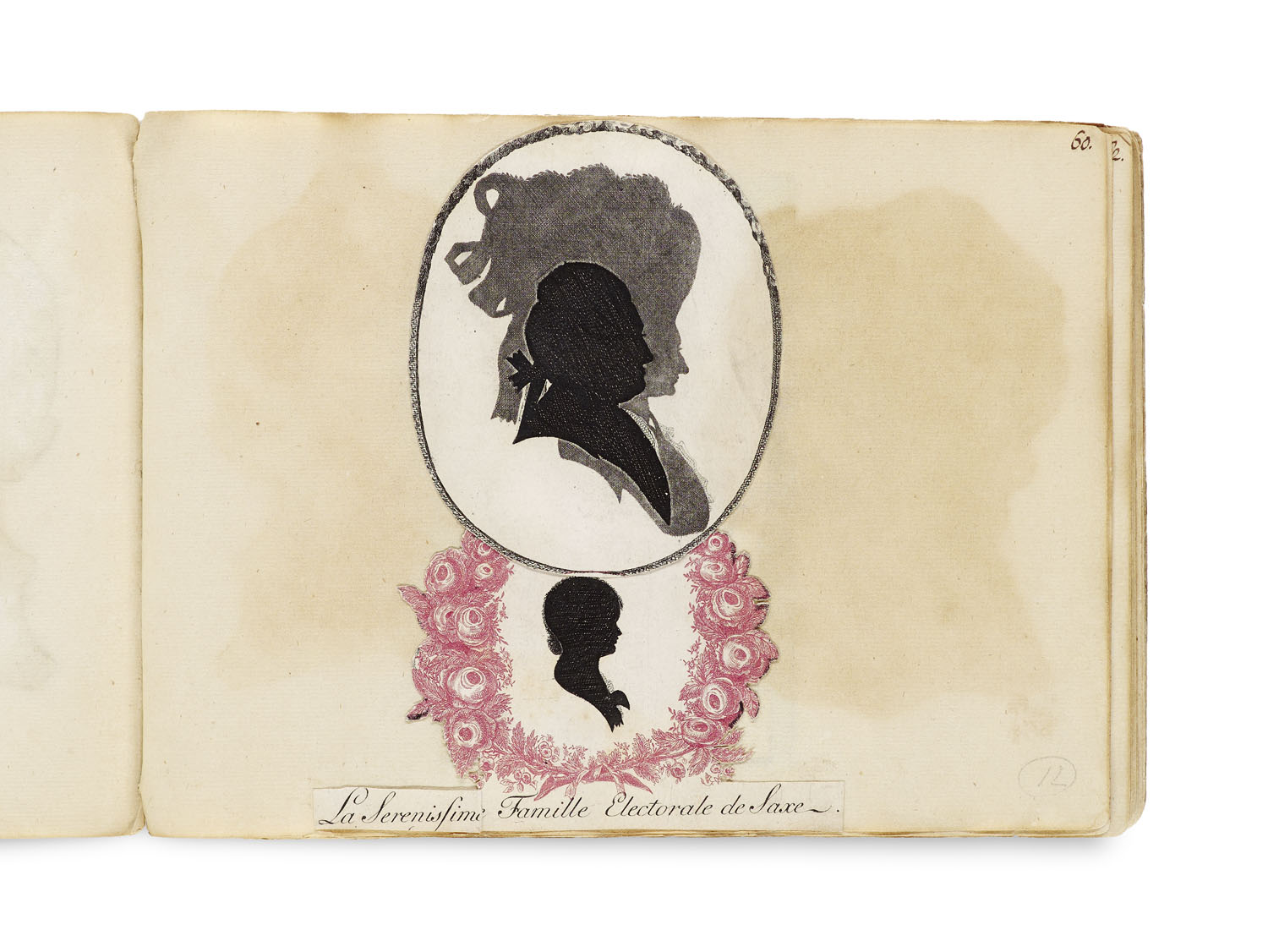
Silhouetten-Album mit 126 geschnittenen Porträts, dazu Porträts in Tusche (2), Zeichnungen (4), Schabkunstblääter (8), Farbstich (2) und Kupferstiche (14). Montiert auf 69 Bll. Die geschnittenen Porträts (meist handschriftlich bezeichnet) ca. 4 x 3,5 bis 10 x 7 cm. In Pp. d. Zt. (stärker beschabt, Rücken mit Fehlstellen, einige Bll. lose). Quer-Gr.-8°. Ende 18. Jh.
Scherenschnitte
Literatur des 17. bis 19. Jahrhunderts – Unter den Dargestellten Lavater, Crusius, Witgenstein, Spangenberg, Schulenburg, Gräfin Reuß, Hardenberg, Wollin, Lykar, Schoenberg, Feder, Hohenthal, Vitzum, Lippe, Graf Brühl, Lykar u.v.a. Das Album entstand in der Blütezeit der Silhouettenmode, die untrennbar mit dem Namen Johann Caspar Lavaters (1741-1801) verbunden ist. Mit seinen zwischen 1775 und 1778 in vier Bänden erschienenen "Physiognomischen Fragmenten zur Beförderung der Menschenkenntniß und Menschenliebe" machte der Zürcher Theologe den Schattenriss - die konturgetreue, seitliche Profildarstellung eines Gesichts - zum zentralen Medium einer neuen, pseudowissenschaftlichen Deutungspraxis: Der Silhouette galt als "unmittelbarer Abdruck der Natur" und damit als objektives Instrument zur Erforschung des menschlichen Charakters. Lavaters eigenes physiognomisches Kabinett wuchs auf über 22.000 Blätter an und befindet sich heute in der Österreichischen Nationalbibliothek. Die enorme Popularität seines Werks, an dem unter anderem Goethe, Merck, Chodowiecki und Füssli mitwirkten, führte dazu, dass sich die Silhouettenkunst binnen kurzer Zeit von einer physiognomischen Studienmethode zu einer breiten gesellschaftlichen Praxis der Bildniserinnerung entwickelte. Dass Lavater selbst unter den Dargestellten des vorliegenden Albums figuriert, verweist unmittelbar auf diesen geistesgeschichtlichen Ursprung der Sammlung. Silhouetten- und Schattenrissalben dieser Art waren im ausgehenden 18. Jahrhundert vor allem in akademischen und höfischen Kreisen ein fester Bestandteil der Freundschafts- und Erinnerungskultur: Studenten, Gelehrte und Angehörige des Adels legten während ihrer Studien- oder Reisejahre Sammlungen von Profilbildnissen ihrer Bekannten, Lehrer und Standesgenossen an - vergleichbar dem bekannten, um 1784-1786 in Göttingen zusammengestellten Freundschaftsalbum des ungarischen Adligen Gregorius Franz von Berzeviczy. Die im vorliegenden Album vertretenen Namen - Schulenburg, Gräfin Reuß, Hardenberg, Hohenthal, Vitzum (von Eckstädt) und Graf Brühl - entstammen durchweg dem mitteldeutschen, vornehmlich sächsisch-thüringischen Hochadel und legen einen ähnlichen Entstehungskontext nahe: ein persönliches Erinnerungs- und Beziehungsalbum aus dem gesellschaftlichen und möglicherweise universitären Umkreis einer adligen oder gelehrten Familie im ausgehenden 18. Jahrhundert. Technik und Zusammensetzung Den Kern des Konvoluts bilden 126 geschnittene Silhouettenporträts in dem für die Gattung charakteristischen kleinen Profilformat von ca. 4 x 3,5 bis 10 x 7 cm, überwiegend zeitgenössisch handschriftlich mit dem Namen des jeweils Dargestellten bezeichnet - eine für Sammelalben dieser Art typische und für die heutige Identifizierbarkeit der Porträtierten entscheidende Praxis. Ergänzt wird die Schnittfolge durch ein bewusst heterogenes Spektrum weiterer Bildnistechniken: zwei Tuschzeichnungen, vier Zeichnungen, acht Schabkunstblätter (Mezzotinto), zwei Farbstiche und vierzehn Kupferstiche. Diese Mischung aus geschnittenen, gezeichneten und gedruckten Porträts ist charakteristisch für gewachsene, über Jahre zusammengetragene Sammelalben, in denen Eigenanfertigungen im Familien- und Freundeskreis mit erworbenen oder geschenkten druckgraphischen Bildnissen kombiniert wurden.
Literature of 17th to 19th Century – Album of silhouettes with 126 cut portraits, together with portraits in ink (2), drawings (4), mezzotint sheets (8), colour engraving (2), and copper engravings (14). Mounted on 69 leaves. The cut portraits (mostly inscribed by hand) ca. 4 x 3.5 to 10 x 7 cm. In a contemporary boards binding (more heavily rubbed, spine with losses, some leaves loose). Oblong large octavo. End of the 18th century. Among those depicted: Lavater, Crusius, Wittgenstein, Spangenberg, Schulenburg, Countess Reuß, Hardenberg, Wollin, Lykar, Schoenberg, Feder, Hohenthal, Vitzum, Lippe, Count Brühl, Lykar, and many others. The album was created during the heyday of the silhouette fashion, a phenomenon inseparably linked to the name of Johann Caspar Lavater (1741-1801). With his "Physiognomische Fragmente zur Beförderung der Menschenkenntniß und Menschenliebe" ("Physiognomical Fragments for the Promotion of Knowledge and Love of Mankind"), published in four volumes between 1775 and 1778, the Zurich theologian made the silhouette - the accurately contoured, lateral profile depiction of a face - the central medium of a new, pseudo-scientific interpretive practice: the silhouette was regarded as an "immediate imprint of nature" and thus as an objective instrument for investigating human character. Lavater's own physiognomic cabinet grew to more than 22,000 sheets and is today housed in the Austrian National Library. The enormous popularity of his work, to which Goethe, Merck, Chodowiecki, and Füssli, among others, contributed, meant that the art of the silhouette rapidly evolved from a physiognomic method of study into a widespread social practice of portrait commemoration. That Lavater himself appears among the sitters of the present album points directly to this intellectual-historical origin of the collection. Silhouette and shadow-profile albums of this kind were, in the late eighteenth century, a fixed component of the culture of friendship and remembrance, particularly within academic and courtly circles: students, scholars, and members of the nobility compiled collections of profile portraits of their acquaintances, teachers, and peers during their years of study or travel - comparable to the well-known friendship album compiled around 1784-1786 in Göttingen by the Hungarian nobleman Gregorius Franz von Berzeviczy. The names represented in the present album - Schulenburg, Countess Reuß, Hardenberg, Hohenthal, Vitzum (von Eckstädt), and Count Brühl - belong throughout to the Central German, predominantly Saxon-Thuringian high nobility, and suggest a similar context of origin: a personal album of remembrance and social connections from the circle - possibly academic - of a noble or scholarly family in the late eighteenth century. Technique and Composition The core of the collection is formed by 126 cut silhouette portraits in the small profile format characteristic of the genre, ca. 4 x 3.5 to 10 x 7 cm, mostly inscribed by a contemporary hand with the name of the sitter - a practice typical of collectors' albums of this kind and crucial to the present-day identification of those portrayed. This sequence of cuttings is supplemented by a deliberately heterogeneous range of further portrait techniques: two ink drawings, four drawings, eight mezzotint sheets, two colour engravings, and fourteen copper engravings. This mixture of cut, drawn, and printed portraits is characteristic of collectors' albums assembled gradually over the years, in which works produced within the family and circle of friends were combined with purchased or gifted portrait prints.
Result: 800 €
Premium and taxation
This piece is subject to differential taxation. There is a 29,85% buyer's premium on the hammer price. The value added tax is included but not displayable according to §25a UstG.
Shipping
A pickup of this work is possible in our premises at Potsdamer Str. 16, 14163 Berlin by appointment. If you wish a shipment of the work, please contact us for a consultation and shipping calculation. Framed tickets are shipped exclusively by a shipping company due to the risk of breakage. Postal shipping is only carried out at the express request and risk of the buyer.
Terms and Conditions
You can view our terms and conditions here
Droit de Suite
On the sales proceeds of all original works of fine art and photography, whose authors have not yet died 70 years before the end of the sale, an additional 2% (subject to change) of the hammer prices from 400€ will be charged pro rata for the VG Bild-Kunst, which represents the copyrights of visual artists according to § 26 UrhG.
Submit a bid
I would like to participate in your auction by accepting the General Terms and Conditions of Jeschke Jádi Auctions Berlin GmbH.