Online Catalogue with all Lots / Auction 161
Wertvolle Bücher, Graphik, Historische Photographie
Saturday, 24 October 2026
Lose 1 - 1706
Lot 771 Jacob Cats. Sammelband mit 3 Werken. Mit …
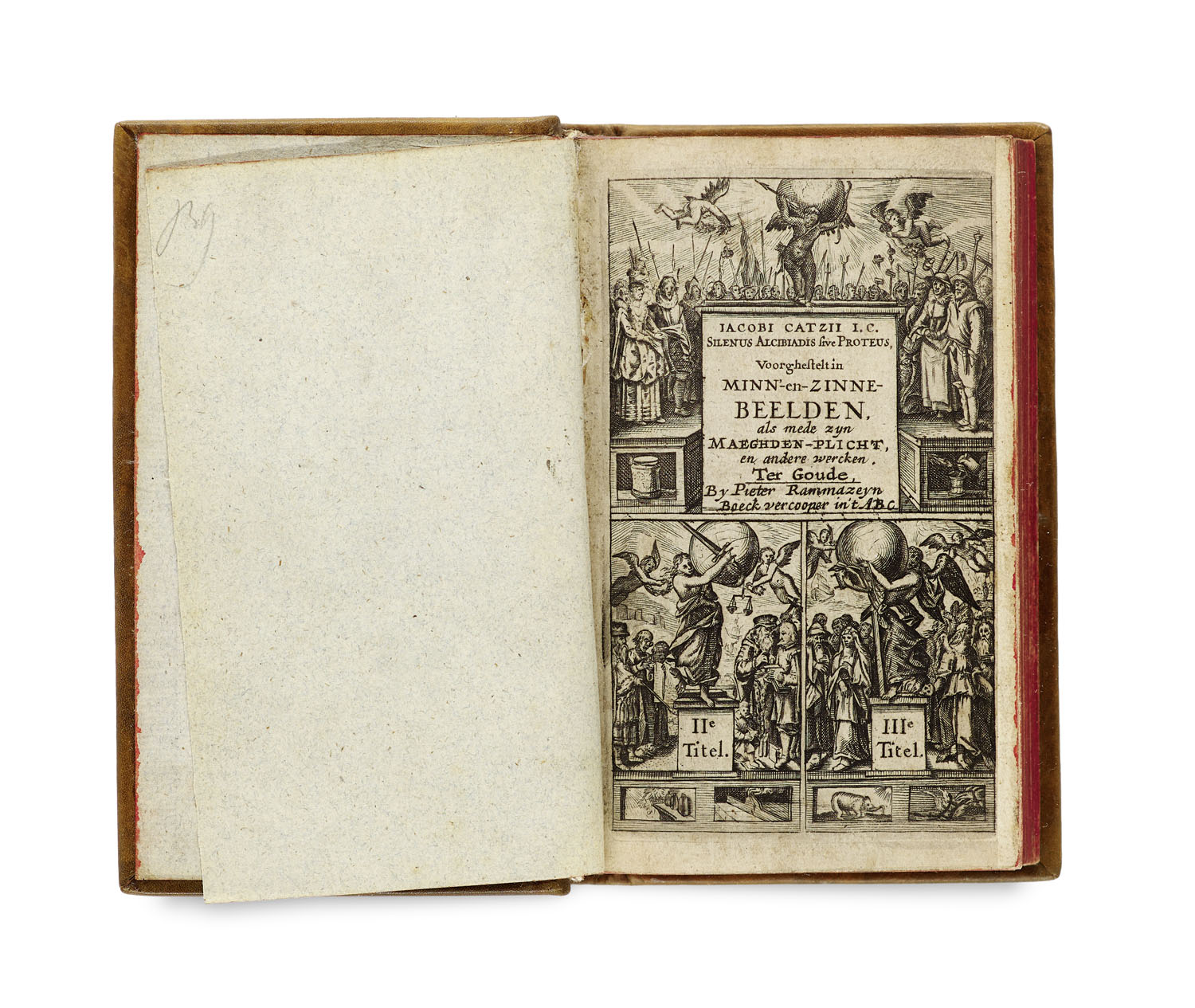
Sammelband mit 3 Werken. Mit zahlreichen, emblematischen Textkupfern. 1. Silenus Alcibiadis sive Proteus voorghestelt in Minn'-en-Zinne-Beelden. Goude, Rammazeyn, ca. 1645. - 2. Self-stryt, Sinne-beelden. Heeren 1645. - 3. Tooneel vande mannelicke acht-baerheyt. Heeren 1645.
Emblemata
Literatur des 17. bis 19. Jahrhunderts – Spätere Ausgabe der bedeutendsten Werke des Dichters Jacob Cats mit eindrucksvollen emblematischen Kupferstichen. - Vgl. Landwehr, Emblem & fable books 115 - Das 2. Werk ist ein langes, hochmoralisches Lehrgedicht, das sich dem inneren Kampf des Menschen zwischen Sünde (Fleisch) und Tugend (Geist) widmet. Der 3. Band ist das Gegenstück für Ehemänner und Männer in Führungspositionen. - Die farbigen Illustrationen in Pochoirkolorit. Jacob Cats (1577-1660) - Jurist, Diplomat, Ratspensionär der Republik der Vereinigten Niederlande und zugleich der meistgelesene Dichter des holländischen Goldenen Zeitalters - gilt als der eigentliche Volksdichter der Niederlande: Allein von seinem Ehestandslehrgedicht "Houwelyck" wurden zwischen 1625 und 1655 rund 50.000 Exemplare verkauft, und noch heute sind zahlreiche seiner Sentenzen als geflügelte Worte im niederländischen Alltagssprachgebrauch lebendig. Sein literarisches Debüt und zugleich sein bekanntestes Werk war der vorliegend erste Titel des Sammelbandes, "Silenus Alcibiadis sive Proteus", erstmals 1618 in Middelburg erschienen. Der doppelbödige Titel spielt auf zwei antike Bildmotive an: den Silen als hässliche äußere Hülle mit kostbarem Inhalt - ein von Erasmus in den "Adagia" verbreitetes Gleichnis für die verhüllte Wahrheit - sowie auf den Meergott Proteus als Sinnbild der Wandelbarkeit. Beide Anspielungen verweisen auf das strukturelle Grundprinzip des Werks: Cats verwendet dieselben Kupferstiche in drei aufeinanderfolgenden Teilen jeweils mit unterschiedlichem Begleittext, sodass ein und dasselbe Bild einmal als Liebesemblem, einmal als moralische Lehre und einmal als religiöse Ermahnung gedeutet wird. Die kreisrunden Embleme der ersten Teile gehen auf Entwürfe Adriaen Pietersz. van de Vennes zurück, der zeit seines Lebens der maßgebliche Bildgestalter für Cats' emblematisches Ouvre blieb, gestochen unter anderem von Jan Gerrits Swelinck. Der zweite im Band vereinte Titel, "Self-stryt" (Selbststreit), ist ein umfangreiches, zutiefst moralisierendes Lehrgedicht, das den inneren Kampf des Menschen zwischen Sünde, verkörpert im Fleisch, und Tugend, verkörpert im Geist, behandelt - ein typisches Beispiel für die didaktisch-religiöse Grundausrichtung, die Cats' gesamtes Werk durchzieht und ihn zum bevorzugten Hausdichter des calvinistisch geprägten Bürgertums machte. Der dritte Titel, "Tooneel vande mannelicke acht-baerheyt" (Schauplatz der männlichen Ehrbarkeit), bildet das komplementäre Gegenstück dazu und richtet sich an Ehemänner sowie an Männer in gesellschaftlichen und amtlichen Führungspositionen, beide Werke erschienen ursprünglich bereits 1620 beziehungsweise 1622 in Middelburg und wurden, wie im vorliegenden Fall, im Laufe des 17. Jahrhunderts wiederholt gemeinsam mit dem "Proteus" zu Sammelbänden vereint. Diese Zusammenstellung der drei zentralen Frühwerke - Liebes- und Sittenlehre, Tugendkampf und Standesethik - ergibt in ihrer Gesamtheit ein kompaktes Kompendium der Cats'schen Morallehre, illustriert durch die charakteristischen, kreisförmigen Kupferstiche, die Bild und Sinnspruch in emblematischer Tradition zu einer untrennbaren Einheit verbinden. Angesichts der außerordentlichen Popularität des Werks erschienen im Laufe des 17. Jahrhunderts zahlreiche, bibliographisch oft nur schwer zu unterscheidende Nachdrucke und Neuauflagen unter wechselnden Verlegern in Amsterdam, Middelburg, Gouda und Den Haag - auch die vorliegende, um 1645 in Gouda bei Rammazeyn erschienene Ausgabe reiht sich in diese lang anhaltende Drucktradition ein, die Landwehrs Standardbibliographie der niederländischen Embleme mit der zitierten Nummer 115 dokumentiert. Etwas gebräunt und teils leicht fleckig.
Literature of 17th to 19th Century – Jacob Cats (1577-1660) - jurist, diplomat, and Grand Pensionary of the Republic of the United Netherlands, as well as the most widely read poet of the Dutch Golden Age - is regarded as the Netherlands' true poet of the people: of his didactic poem on marriage, "Houwelyck," alone, some 50,000 copies were sold between 1625 and 1655, and many of his maxims remain proverbial expressions in everyday Dutch speech to this day. His literary debut, and at the same time his most famous work, was the first title bound in the present volume, "Silenus Alcibiadis sive Proteus," first published in Middelburg in 1618. The double-edged title alludes to two motifs from antiquity: the Silenus figure as an ugly outer shell concealing precious contents - an image popularized by Erasmus in his "Adagia" as an allegory of veiled truth - and the sea god Proteus as a symbol of mutability. Both allusions point to the work's underlying structural principle: Cats uses the same engravings across three successive parts, each with a different accompanying text, so that one and the same image is interpreted once as an emblem of love, once as a moral lesson, and once as a religious admonition. The circular emblems of the first parts go back to designs by Adriaen Pietersz. van de Venne, who remained the principal image-maker for Cats's emblematic oeuvre throughout his life, engraved among others by Jan Gerrits Swelinck. The second title united in the volume, "Self-stryt" ("Inner Strife"), is an extensive, deeply moralizing didactic poem dealing with man's inner struggle between sin, embodied in the flesh, and virtue, embodied in the spirit - a typical example of the didactic-religious orientation that runs through Cats's entire body of work and made him the favourite household poet of the Calvinist-minded bourgeoisie. The third title, "Tooneel vande mannelicke acht-baerheyt" ("A Display of Manly Honour"), forms its complementary counterpart, addressed to husbands as well as to men in positions of social and official leadership, both works were originally published in 1620 and 1622 respectively in Middelburg, and were, as in the present case, repeatedly bound together with "Proteus" into composite volumes over the course of the seventeenth century. Taken together, this combination of the three central early works - teachings on love and morals, the struggle of virtue, and the ethics of social standing - forms a compact compendium of Cats's moral doctrine, illustrated by the characteristic circular engravings that unite image and maxim into an inseparable whole in the emblematic tradition. Given the extraordinary popularity of the work, numerous reprints and new editions, often bibliographically difficult to distinguish from one another, appeared over the course of the seventeenth century under various publishers in Amsterdam, Middelburg, Gouda, and The Hague - the present edition too, published around 1645 in Gouda by Rammazeyn, belongs to this long-running printing tradition, documented under the cited number 115 in Landwehr's standard bibliography of Dutch emblem books.
Startprice: 600 €
Estimate: 800 €
Premium and taxation
This piece is subject to differential taxation. There is a 29,85% buyer's premium on the hammer price. The value added tax is included but not displayable according to §25a UstG.
Shipping
A pickup of this work is possible in our premises at Potsdamer Str. 16, 14163 Berlin by appointment. If you wish a shipment of the work, please contact us for a consultation and shipping calculation. Framed tickets are shipped exclusively by a shipping company due to the risk of breakage. Postal shipping is only carried out at the express request and risk of the buyer.
Terms and Conditions
You can view our terms and conditions here
Droit de Suite
On the sales proceeds of all original works of fine art and photography, whose authors have not yet died 70 years before the end of the sale, an additional 2% (subject to change) of the hammer prices from 400€ will be charged pro rata for the VG Bild-Kunst, which represents the copyrights of visual artists according to § 26 UrhG.
Submit a bid
I would like to participate in your auction by accepting the General Terms and Conditions of Jeschke van Vliet Auctions Berlin GmbH.