Online Catalogue with all Lots / Auction 161
Wertvolle Bücher, Graphik, Historische Photographie
Saturday, 24 October 2026
Lose 1 - 1706
Lot 395 Zehnteiliger …
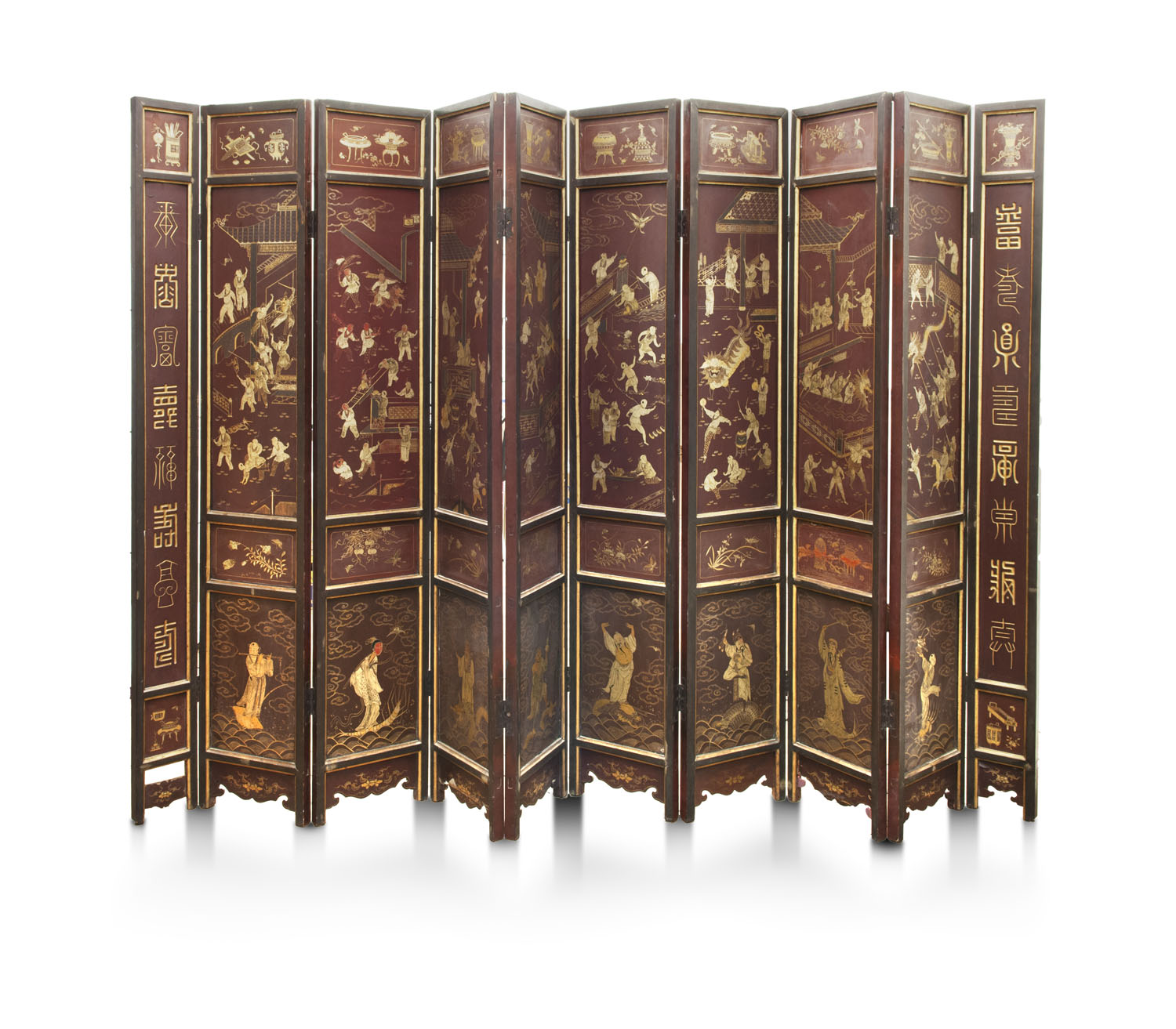
Zehnteiliger Koromandel-Lackparavent, China, Provinz Fujian oder Guangdong, Qing-Dynastie, Kangxi-Periode, um 1800/1850. 167 x 265 x 3 cm. - Das Holz an den Kanten teils leicht abgestoßen. Stellenweise kleinere Beschädigungen des Lacks. Die Farbe teils minimal abgetragen.
China
Geographie und Reisen – Dunkel weinrot bis braunschwarz lackierter, zehnteiliger Klappschirm auf Holzkorpus, in Kuancai-Technik (eingeritztes und teilvergoldetes Bunt) gearbeitet. Die zehn scharniergebundenen Paneele zeigen ein dreizoniges Bildprogramm: im oberen, schmalen Register antike Ritualgefäße und Vasen im Bogu-Stil, in den großformatigen Hauptfeldern zahlreiche spielende Knaben in palastartiger Garten- und Pavillonarchitektur (Baizi-Tu, "Hundert-Knaben"-Motiv) sowie im unteren Register einzelne, auf Wolken- und Wellenbändern stehende Unsterblichenfiguren (Xian). Die beiden äußersten Flügel tragen vertikale, goldene Kalligraphie-Kartuschen mit vermutlich glückverheißender Widmungsinschrift. Die Bildmotive sind durch die dunkle Lackschicht bis auf die helle Kreidegrundierung eingeritzt bzw. geschnitzt und anschließend farbig gefasst und partiell vergoldet, sodass die Figuren goldglänzend vor dem tiefroten Fond erscheinen - eine für Prunk- und Geschenkschirme der frühen Qing-Zeit charakteristische Ausführung. Solche Koromandelschirme wurden vorwiegend in den südchinesischen Küstenprovinzen Fujian und Guangdong hergestellt, den zentralen Produktionsgebieten für den Export- und Repräsentationsmarkt, von wo sie über den Hafen Canton (Guangzhou) und weiter über die indische Koromandelküste nach Europa verschifft wurden - daher der im Westen gebräuchliche Name. Die Kombination aus Bogu-Fries, Baizi-Tu-Hauptmotiv und kalligraphischer Widmungskartusche sowie die kräftige, dunkel-weinrote Lackfassung mit Goldakzentuierung entsprechen dem Formenkanon der Kangxi-Periode (1662-1722), in der solche mehrteiligen Prunkschirme ihre Blütezeit erlebten und in großer Zahl als Geburtstags- und Ehrengeschenke sowie für den europäischen Exporthandel gefertigt wurden.
Geography and Travel – Ten-panel Coromandel lacquer screen, China, Fujian or Guangdong province, Qing dynasty, Kangxi period, circa 1800/1850. 167 x 265 x 3 cm. - The wood slightly chipped at the edges in places. Minor damage to the lacquer in scattered spots. The colour minimally worn in places. Ten-fold folding screen on a wooden carcass, lacquered in a dark wine-red to blackish-brown tone, worked in the kuancai technique (incised and partially gilded polychrome). The ten hinge-joined panels display a three-tiered pictorial programme: in the narrow upper register, antique ritual vessels and vases in the bogu style, in the large main fields, numerous boys at play within a palace-like garden and pavilion setting (baizi tu, the "hundred boys" motif), and in the lower register, individual immortal figures (xian) standing on bands of clouds and waves. The two outermost leaves bear vertical, gold calligraphic cartouches with what is presumably an auspicious dedicatory inscription. The decoration is incised or carved through the dark lacquer layer down to the pale chalk ground, then polychrome-painted and partially gilded, so that the figures appear in gleaming gold against the deep red field - an execution characteristic of ceremonial and presentation screens of the early Qing period. Coromandel screens of this type were produced chiefly in the southern Chinese coastal provinces of Fujian and Guangdong, the principal centres of manufacture for the export and prestige market, from where they were shipped via the port of Canton (Guangzhou) and onward along the Indian Coromandel coast to Europe - hence the name by which they became known in the West. The combination of the bogu border, the baizi tu main motif, and the calligraphic dedicatory cartouche, together with the bold, dark wine-red lacquer ground accented in gold, correspond to the formal canon of the Kangxi period (1662-1722), during which such multi-panel ceremonial screens reached their artistic peak and were produced in large numbers both as birthday and honorary gifts and for the European export trade.
Startprice: 600 €
Estimate: 750 €
Premium and taxation
This piece is subject to differential taxation. There is a 29,85% buyer's premium on the hammer price. The value added tax is included but not displayable according to §25a UstG.
Shipping
A pickup of this work is possible in our premises at Potsdamer Str. 16, 14163 Berlin by appointment. If you wish a shipment of the work, please contact us for a consultation and shipping calculation. Framed tickets are shipped exclusively by a shipping company due to the risk of breakage. Postal shipping is only carried out at the express request and risk of the buyer.
Terms and Conditions
You can view our terms and conditions here
Droit de Suite
On the sales proceeds of all original works of fine art and photography, whose authors have not yet died 70 years before the end of the sale, an additional 2% (subject to change) of the hammer prices from 400€ will be charged pro rata for the VG Bild-Kunst, which represents the copyrights of visual artists according to § 26 UrhG.
Submit a bid
I would like to participate in your auction by accepting the General Terms and Conditions of Jeschke van Vliet Auctions Berlin GmbH.