Online Catalogue with all Lots / Auction 161
Rare Books, Prints, Historical Photography
Saturday, 24 October 2026
Lose 1 - 1706 - After sale
Lot 1650 Carl Ritter von Ghega. Atlante di 8 tavole al quadro …
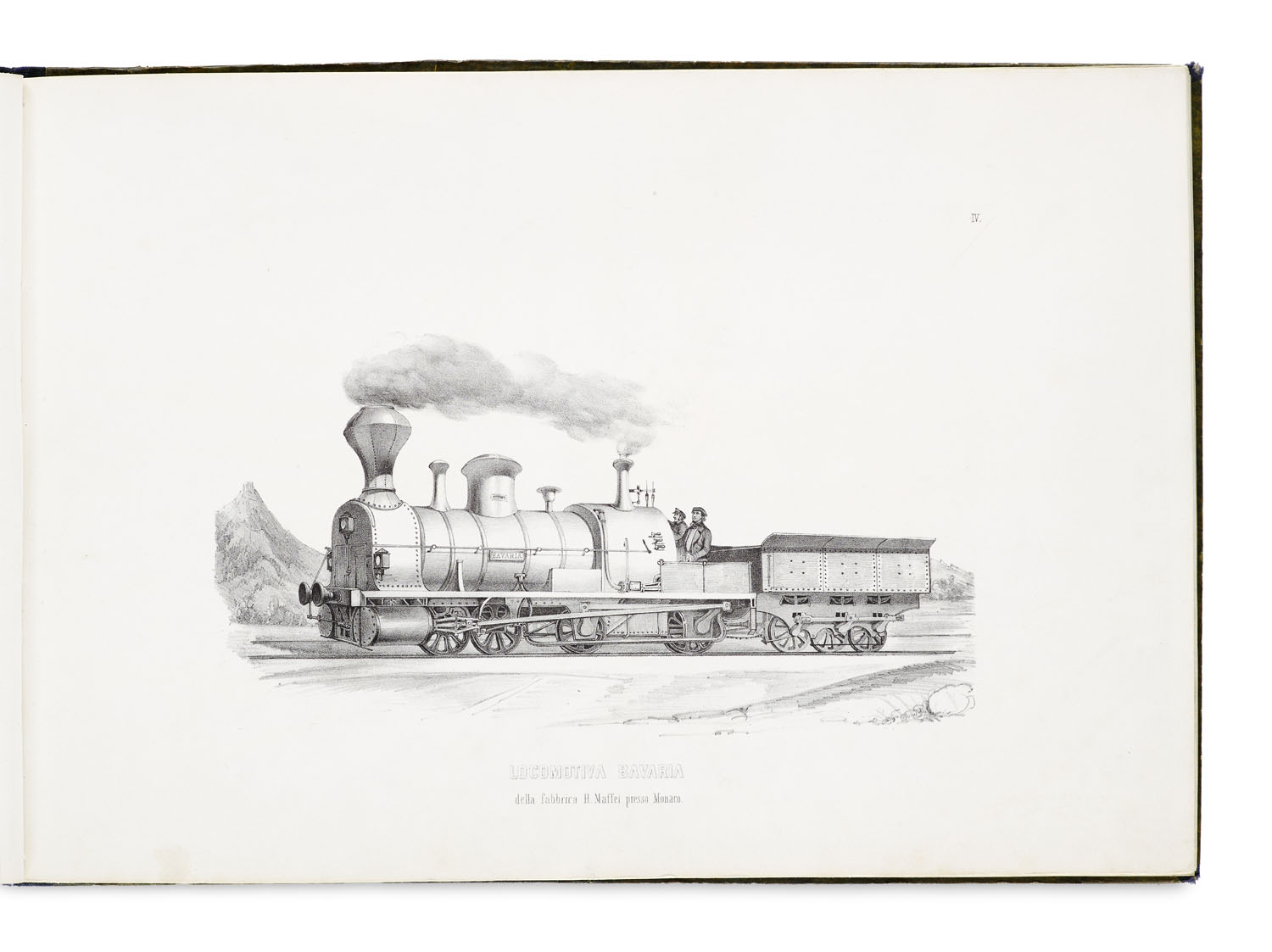
Atlante di 8 tavole al quadro dei progressi principali delle strade ferrate del decennio 1840-1850 e dei risultamenti delle corse di prova con le locomotive di concorso sull' J. R. strada ferrata sul Semmering in Austria. Seconda edizione corretta ed ampliata. Mit lith. Titel, 1 gefalteten Karte, und 7 weiteren Tafeln auf 8 Blättern. Wien, o.Dr., 1852. Quer-Folio (30 x 44 cm). HLwd. d. Zt. in mod. Ldr.-Kassette (etwas berieben).
Eisenbahn
Technik – Wurzbach V, 168. Vgl. Nebehay-Wagner 1060. - Seltene zweite, verbesserte und erweiterte Ausgabe des großformatigen Tafelatlasses zu Carlo Ghegas Darstellung der Fortschritte des Eisenbahnwesens im Jahrzehnt 1840-1850 sowie der Probefahrten im Rahmen des berühmten Semmering-Lokomotivwettbewerbs. Das Werk dokumentiert einen entscheidenden Moment der europäischen Verkehrsgeschichte: die technische Erprobung von Lokomotiven für eine Bahnstrecke, deren schwierige Topographie mit engen Bögen, starken Steigungen und alpinem Gelände die bisherigen Maßstäbe des Eisenbahnbaus übertraf. Carlo Ghega (1802-1860), seit 1851 Ritter von Ghega, war der leitende Ingenieur der Semmeringbahn. Die zwischen 1848 und 1854 errichtete Strecke von Gloggnitz nach Mürzzuschlag führte auf rund 41 km durch hochalpines Gelände und gilt als eines der bedeutendsten Ingenieurprojekte der frühen Eisenbahnzeit. Ihre Trassierung bewies, dass leistungsfähige Adhäsionsbahnen auch in Gebirgsregionen ohne Zahnradtechnik wirtschaftlich und betriebssicher realisierbar waren. Besonderen Reiz besitzt der Atlas durch die bildliche Dokumentation des 1851 ausgeschriebenen Lokomotivwettbewerbs. Die kaiserlich-königliche Verwaltung suchte geeignete Maschinen für den künftigen Betrieb auf der Semmeringstrecke, die Versuchsergebnisse lieferten wesentliche Grundlagen für die Entwicklung leistungsfähiger Gebirgslokomotiven. Karte und Tafeln veranschaulichen Ghegas ingenieurtechnische, statistische und betriebliche Argumentation und sind zugleich wichtige Quellen zur Geschichte des frühen Lokomotivbaus. Bedeutendes und seltenes Werk zur österreichischen Eisenbahn- und Technikgeschichte, zur Entwicklung des europäischen Gebirgsbahnbaus sowie zur Planungsgeschichte der später als UNESCO-Welterbe ausgezeichneten Semmeringbahn. - Gering finger- und unscheinbar braunfleckig. Buchblock nahezu von Rücken gelöst. Insgesamt gutes Exemplar.
Technique – With a lithographed title page, 1 folded map, and 7 additional plates on 8 sheets. - Rare second, revised, and expanded edition of the large-format atlas of plates accompanying Carlo Ghega's account of railway advancements during the decade 1840-1850 and the trial runs conducted as part of the famous Semmering locomotive competition. The work documents a pivotal moment in European transport history: the technical testing of locomotives for a railway line whose challenging topography-characterized by tight curves, steep gradients, and alpine terrain-surpassed the prevailing standards of railway construction. Carlo Ghega (1802-1860)-ennobled as Ritter von Ghega in 1851-was the lead engineer of the Semmering Railway. Built between 1848 and 1854, the line running from Gloggnitz to Mürzzuschlag traversed approximately 41 kilometers of high-alpine terrain and is considered one of the most significant engineering projects of the early railway era. Its route design demonstrated that high-performance adhesion railways-relying on wheel-to-rail friction rather than rack-and-pinion systems-could be realized economically and safely even in mountainous regions. The atlas holds particular appeal due to its visual documentation of the locomotive competition announced in 1851. The Imperial-Royal administration sought suitable engines for future operations on the Semmering line, the test results provided essential data for the development of powerful mountain locomotives. The map and plates illustrate Ghega's engineering, statistical, and operational arguments while serving as vital sources for the history of early locomotive construction. A significant and rare work on the history of Austrian railways and technology, the development of European mountain railway construction, and the planning history of the Semmering Railway-later designated a UNESCO World Heritage Site. - Minor traces of handling and faint brown spotting. Text block nearly detached from the spine. Overall a good copy.
Result: 500 € (Under reservation)
Post Auction Price: 700 €
Premium and taxation
This work is subject to under the regular margin scheme. There is a 24.95% buyer's premium on the hammer price and inside the EU 7% (Books, Paintings, Drawings and most Prints) and 19% (Photographs, Screen and Offsetprints, Autographs and Manuscripts) VAT on the final invoice amount.
Shipping
A pickup of this work is possible in our premises at Potsdamer Str. 16, 14163 Berlin by appointment. If you wish a shipment of the work, please contact us for a consultation and shipping calculation. Framed tickets are shipped exclusively by a shipping company due to the risk of breakage. Postal shipping is only carried out at the express request and risk of the buyer.
Terms and Conditions
You can view our terms and conditions here
Droit de Suite
On the sales proceeds of all original works of fine art and photography, whose authors have not yet died 70 years before the end of the sale, an additional 2% (subject to change) of the hammer prices from 400€ will be charged pro rata for the VG Bild-Kunst, which represents the copyrights of visual artists according to § 26 UrhG.
Submit a bid
I would like to participate in your auction by accepting the General Terms and Conditions of Jeschke Jádi Auctions Berlin GmbH.