Online Catalogue with all Lots / Auction 161
Rare Books, Prints, Historical Photography
Saturday, 24 October 2026
Lose 1 - 1706
Lot 1645 Friedrich Knauss von. Selbstschreibende …
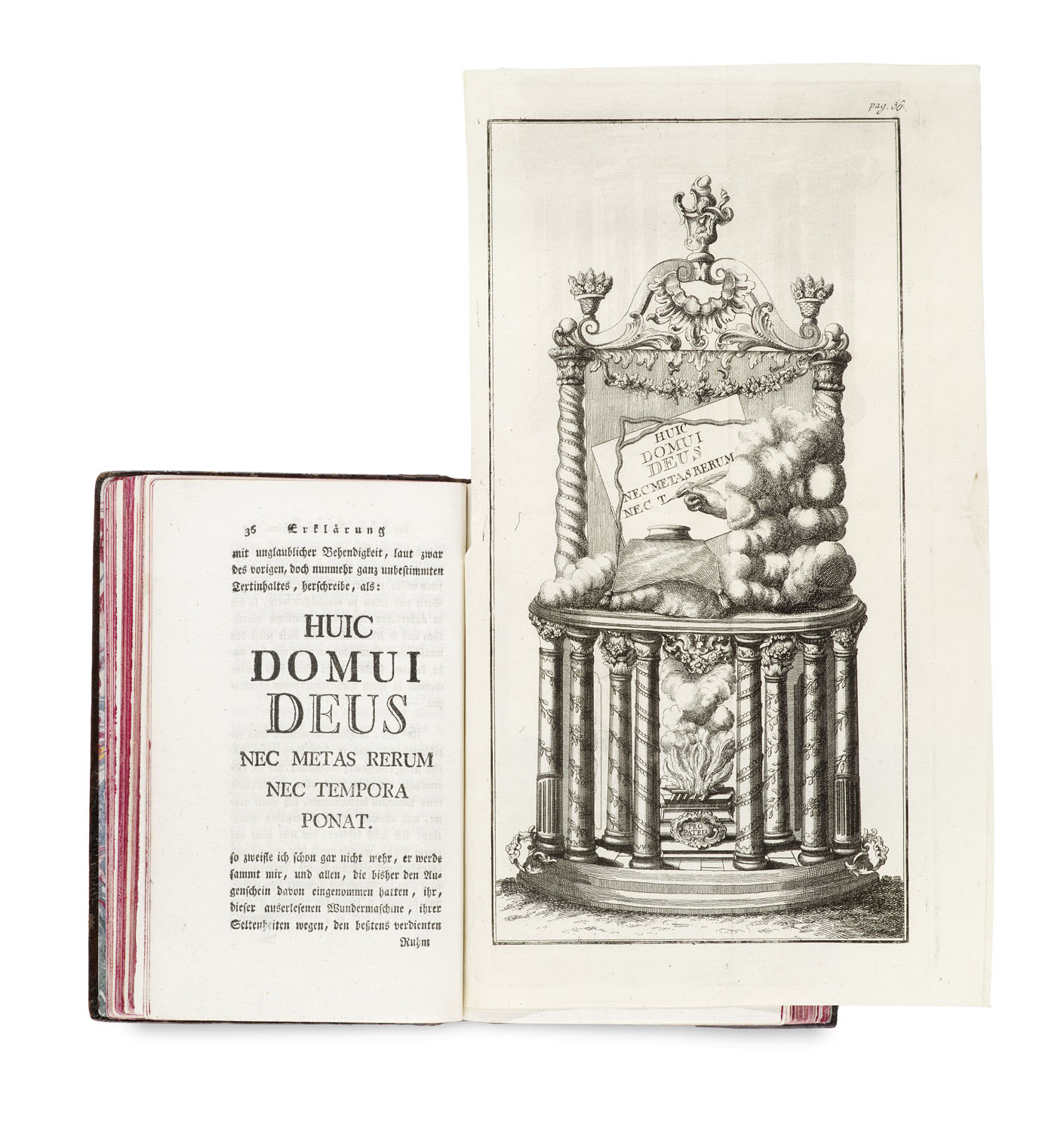
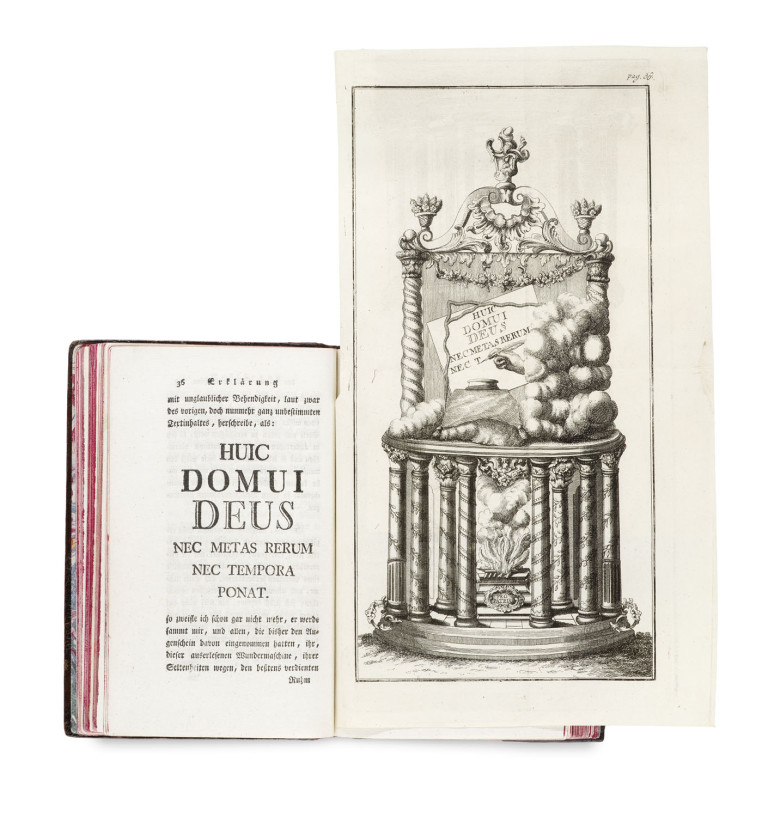
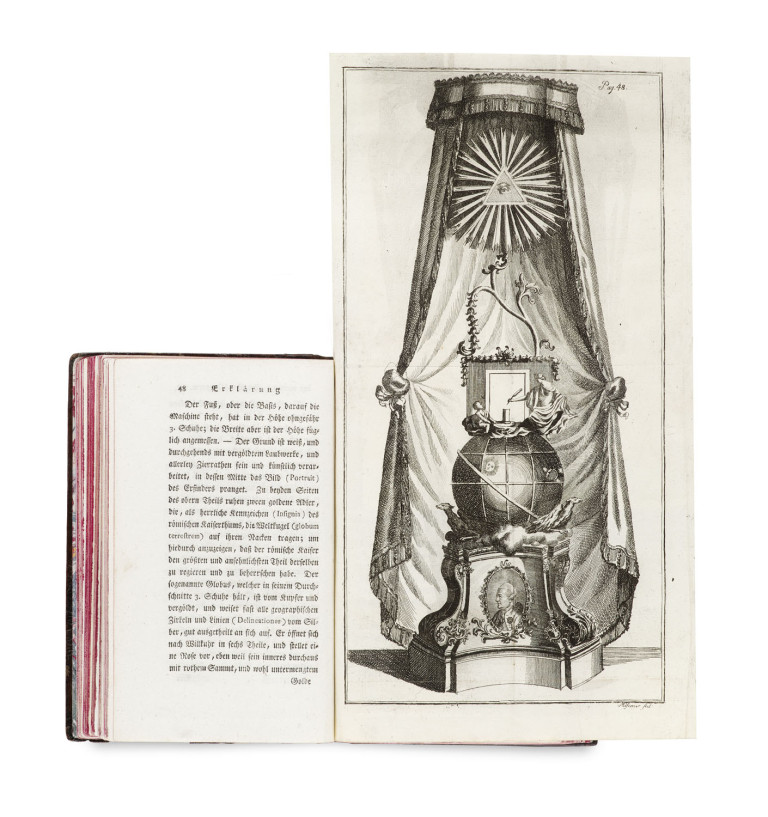
Selbstschreibende Wundermaschinen, auch mehr andere Kunst- und Meisterstücken, als so viele nunmehr aufgelöste Problemen. Mit gestochenen Frontispiz (Portrait) und 11 (10 gefaltete) Kupfertafeln. Wien, Selbstverlag (Schulz-Gastheim), 1780. (18), 170, (2) S. Ldr. d. Zt. mit RSchild.
Automaten
Technik – Poggendorff I, 1279. - UCBA II, 1098. - NDB XII, 162. - Erste und einzige Ausgabe der von Friedrich von Knauss (1724-1789) selbst verfassten und im Selbstverlag veröffentlichten Beschreibung seiner mechanischen Automaten. Knauss, geboren in Aldingen am Neckar, wirkte seit 1749 als Uhrmacher und Mechaniker in den Diensten Karls von Lothringen und folgte diesem 1757 nach Wien, wo ihn Kaiser Franz I. Stephan zum Hofmechanikus ernannte. Am Wiener Hof war er als Inspektor des mathematisch-physikalischen Kabinetts tätig und avancierte zu einem der bedeutendsten Automatenbauer des 18. Jahrhunderts. Den Kern seines Schaffens bilden die selbstschreibenden Maschinen, deren berühmteste, die 1760 Kaiser Franz I. präsentierte "alles- oder selbstschreibende Wundermaschine", mittels Feder, Hebel- und Abtastmechanismen die Schreibbewegung der menschlichen Hand nachahmte und in der Lage war, 68 lateinische Zeichen zu schreiben, bei der Erstaufführung verfasste der Automat einen Brief in französischer Sprache. Diese Konstruktion - ein von zwei bronzenen Adlern getragener Globus mit sechs aufklappbaren Segmenten, der das Uhrwerk-Schreibmechanismus verbirgt und von einer allegorischen Figur bekrönt wird, die mit der Feder die vorgegebenen Buchstaben zu Papier bringt - zählt zu den frühesten bekannten Schreibautomaten und gilt neben denen der Familie Jaquet-Droz als Meilenstein der Automatengeschichte. Daneben entwickelte Knauss für den Kaiser eine Kopiermaschine, mit der mehrere Abschriften eines Schriftstücks gleichzeitig angefertigt werden konnten. Die ACM (Association for Computing Machinery) führt Knaus' Schreibautomaten explizit in ihrer Übersicht zur globalen Computergeschichte auf und bezeichnet ihn als "programmable automatic handwriting machine". Damit reiht sich Knauss in eine Traditionslinie mechanischer Automaten des 18. Jahrhunderts ein, die zum ersten Mal Geräte mit komplexem, gespeichertem Ablaufprogramm realisierten - etwa auch Jacques de Vaucansons Flötenspieler (1737) und dessen später von Jacquard weiterentwickelte Lochkarten-Steuerung. - Eine Kupfertafel etwas knapp bis zur Einfassungslinie beschnitten, 2 Kupfertafeln minimal fleckig, davon 1 Kupfertafel mit 2 kleinen restaurierten Löchlein (winziger Bildverlust), sonst gutes, sauberes Exemplar. Sehr selten.
Technique – First and only edition of the description of his mechanical automatons, written and published at his own expense by Friedrich von Knauss (1724-1789). Knauss, born in Aldingen am Neckar, worked from 1749 as a watchmaker and mechanic in the service of Charles of Lorraine and followed him to Vienna in 1757, where Emperor Franz I Stephan appointed him court mechanic. At the Viennese court he served as inspector of the mathematical-physical cabinet and rose to become one of the most important builders of automatons of the eighteenth century. The core of his work consists of the self-writing machines, the most famous of which, the "all-writing" or "self-writing miraculous machine" presented to Emperor Franz I in 1760, imitated the writing motion of the human hand by means of a pen, levers, and cam mechanisms and was capable of writing 68 Latin characters, at its first demonstration the automaton composed a letter in French. This construction - a globe borne by two bronze eagles with six hinged segments concealing the clockwork writing mechanism, crowned by an allegorical figure that commits the prescribed letters to paper with a pen - ranks among the earliest known writing automatons and, alongside those of the Jaquet-Droz family, is regarded as a milestone in the history of automatons. In addition, Knauss developed for the emperor a copying machine capable of producing several copies of a document simultaneously. The ACM (Association for Computing Machinery) explicitly lists Knaus's writing automaton in its overview of global computing history, describing it as a "programmable automatic handwriting machine." Knauss thus takes his place in a line of eighteenth-century mechanical automatons that were the first to realize devices with a complex, stored sequence of operations - among them also Jacques de Vaucanson's flute player (1737) and its punch-card control system, later developed further by Jacquard. One copper plate trimmed rather closely to the border line, 2 copper plates with minimal foxing, of which 1 copper plate has 2 small restored pinholes (negligible loss to the image), otherwise a fine, clean copy. Very rare.
Startprice: 3600 €
Estimate: 4500 €
Premium and taxation
This work is subject to under the regular margin scheme. There is a 24.95% buyer's premium on the hammer price and inside the EU 7% (Books, Paintings, Drawings and most Prints) and 19% (Photographs, Screen and Offsetprints, Autographs and Manuscripts) VAT on the final invoice amount.
Shipping
A pickup of this work is possible in our premises at Potsdamer Str. 16, 14163 Berlin by appointment. If you wish a shipment of the work, please contact us for a consultation and shipping calculation. Framed tickets are shipped exclusively by a shipping company due to the risk of breakage. Postal shipping is only carried out at the express request and risk of the buyer.
Terms and Conditions
You can view our terms and conditions here
Droit de Suite
On the sales proceeds of all original works of fine art and photography, whose authors have not yet died 70 years before the end of the sale, an additional 2% (subject to change) of the hammer prices from 400€ will be charged pro rata for the VG Bild-Kunst, which represents the copyrights of visual artists according to § 26 UrhG.
Submit a bid
I would like to participate in your auction by accepting the General Terms and Conditions of Jeschke van Vliet Auctions Berlin GmbH.