Online Catalogue with all Lots / Auction 161
Rare Books, Prints, Historical Photography
Saturday, 24 October 2026
Lose 1 - 1706 - After sale
Lot 157 Homiliar für das …
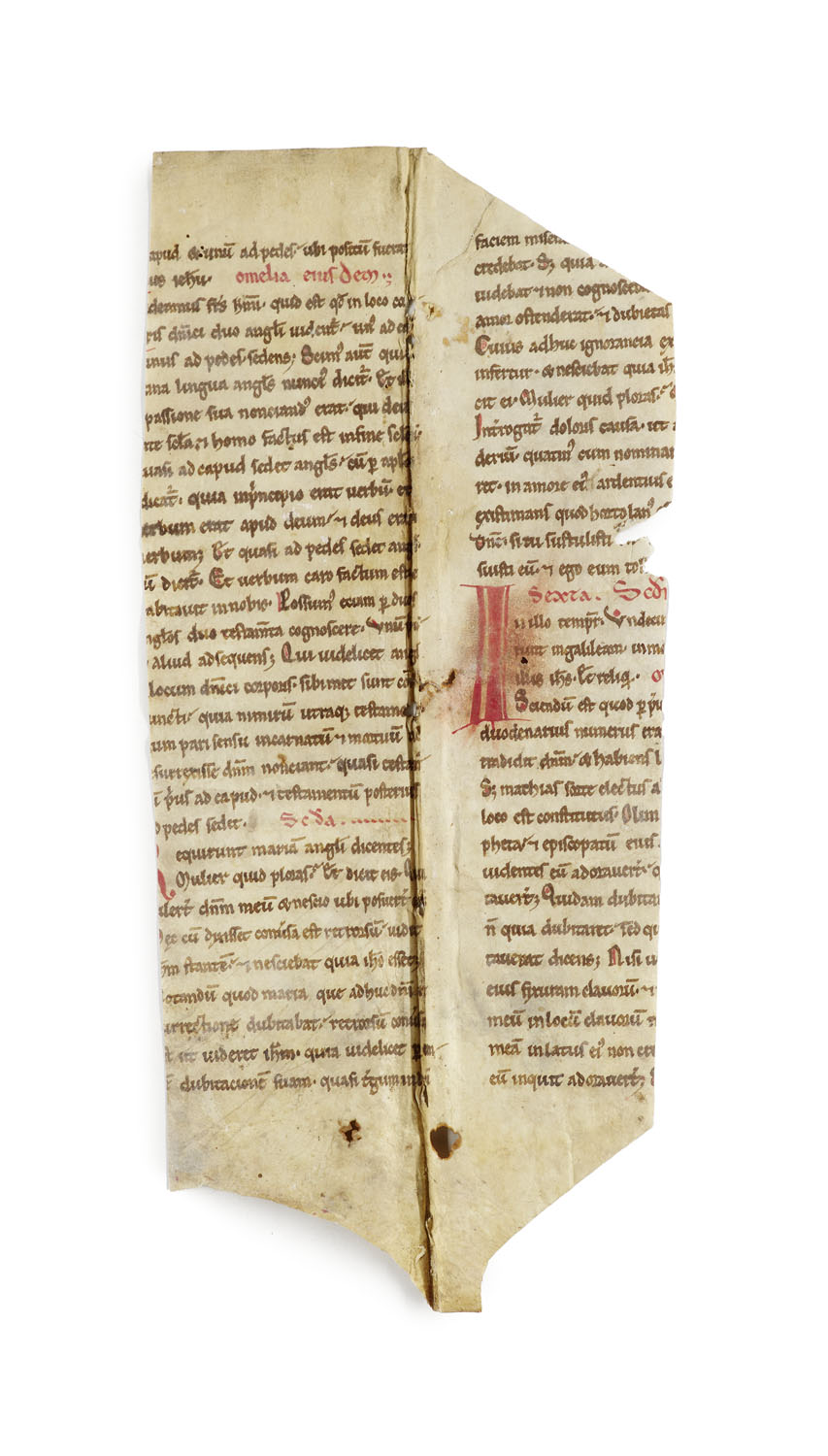
Homiliar für das Nachtoffizium (Matutin) der Osteroktav. Mit einer roten Intiale, rote Lombarden und weitere rote Auszeichnungen. Lateinische Handschrift auf Pergament. Relativ rundliche frühgotische Textura. Etwa 20 bis 25 Zeilen. Schriftraum ca. 21,6 x 6,5 cm. 29,5 x 13,4 cm. Wohl südlicher deutschsprachiger Raum (Bayern oder Österreich), um 1250-1300.
Mittelalter
Manuskripte und Urkunden – Zur Paläographie: Die Schrift ist eine sorgfältige, noch relativ rundliche frühgotische Textura von einer Hand. Die roten Rubriken stammen wohl vom selben Schreiber. Charakteristisch sind das zweistöckige a, das überwiegend unziale d, runde und lange s-Formen und teils ein rundes r nach Rundbuchstaben. Hinzu kommen Bogenverbindungen, ct- und st-Ligaturen und eine mäßige Schaftbrechung ohne ausgeprägte Quadrangeln. Das Kürzungssystem ist üblich (Nasalstrich, p-Kürzungen, Nomina sacra). Interpungiert wird mit Punkt und Punctus elevatus. Korrekturen oder Nachträge sind nicht erkennbar. Die Datierung in die zweite Hälfte des 13. Jahrhunderts, möglicherweise um 1300, stützt sich auf die noch nicht streng formalisierte Textura und die schlichte Lombarden-Ausstattung. Zum Inhalt: Vorliegend ein Fragment eines Homiliar, also eine Sammlung von Predigten zu den Evangelien des Kirchenjahres, hier in der Osterwoche. Die Rubrik "Sexta" verweist auf die Lesung für den Freitag. Erkennbar sind Auslegungen zu drei Evangelienstellen. Die erste betrifft Joh 20,11-18, Maria Magdalena am Grab. Lesbar sind "Maria stabat ad monumentum foris plorans" und "Mulier quid ploras?" sowie die Deutung der beiden Engel in weißen Gewändern, die an Kopf- und Fußende der Grabstätte sitzen. Die Predigt fasst sie als Sinnbild der beiden Testamente auf und beginnt mit dem Hinweis auf die entflammte Liebe Marias. Die zweite Stelle ist Joh 21, der Fischfang. Die Rede ist vom Fischen und vom Auswerfen des Netzes auf der rechten Seite, mit allegorischer Deutung auf die Kirche und die Erwählten. Die dritte ist Mt 28,16-17, die elf Jünger, die nach Galiläa auf den Berg gehen. Die Auslegung geht auf die Zwölfzahl der Apostel, die Nachwahl des Matthias und den Zweifel einiger Jünger ein. Der Wortlaut der Auslegung zu Joh 20 erinnert deutlich an die Evangelienhomilien Gregors des Großen (Homiliae in Evangelia, Hom. 25). Die übrigen Abschnitte könnten ebenfalls von Gregor stammen oder aus einem anderen Homiliar übernommen sein, etwa von Haimo von Auxerre oder Beda.
Manuscripts – Middle Ages - Homiliary for the night office (Matins) of the Easter octave. With one red initial, red lombardic initials and further red rubrication. Relatively rounded early Gothic Textura. Approx. 20 to 25 lines. Written space approx. 21.6 x 6.5 cm. 29.5 x 13.4 cm. Probably southern German-speaking region (Bavaria or Austria), c. 1250-1300. On the palaeography: The script is a careful early Gothic Textura, still relatively rounded, written by a single hand. The red rubrics were probably written by the same scribe. Characteristic features are the two-compartment a, the predominantly uncial d, round and long forms of s, and, in places, a round r after round letters. There are also biting of curves (bows), ct and st ligatures, and moderate breaking of the shafts without pronounced quadrangles. The system of abbreviation is the usual one (nasal bar, p-abbreviations, nomina sacra). Punctuation is by punctus and punctus elevatus. No corrections or later additions are visible. The dating to the second half of the 13th century, possibly c. 1300, rests on the Textura, which is not yet strictly formalised, and on the plain lombardic decoration. On the content: The present item is a fragment of a homiliary, that is, a collection of sermons on the Gospels of the liturgical year, here for Easter week. The rubric "Sexta" refers to the reading for Friday. Commentaries on three Gospel passages can be identified. The first concerns John 20:11-18, Mary Magdalene at the tomb. Legible are "Maria stabat ad monumentum foris plorans" and "Mulier quid ploras?", as well as the interpretation of the two angels in white garments sitting at the head and the foot of the burial place. The sermon takes them as a symbol of the two Testaments and begins with a reference to Mary's ardent love. The second passage is John 21, the miraculous catch of fish. It speaks of fishing and of casting the net on the right-hand side, with an allegorical interpretation referring to the Church and the elect. The third is Matthew 28:16-17, the eleven disciples going to the mountain in Galilee. The commentary deals with the number twelve of the apostles, the election of Matthias, and the doubt of some of the disciples. The wording of the commentary on John 20 is clearly reminiscent of the Gospel homilies of Gregory the Great (Homiliae in Evangelia, Hom. 25). The other sections could also be by Gregory, or taken from another homiliary, for example by Haymo of Auxerre or Bede.
Post Auction Price: 1000 €
Premium and taxation
This work is subject to under the regular margin scheme. There is a 24.95% buyer's premium on the hammer price and inside the EU 7% (Books, Paintings, Drawings and most Prints) and 19% (Photographs, Screen and Offsetprints, Autographs and Manuscripts) VAT on the final invoice amount.
Shipping
A pickup of this work is possible in our premises at Potsdamer Str. 16, 14163 Berlin by appointment. If you wish a shipment of the work, please contact us for a consultation and shipping calculation. Framed tickets are shipped exclusively by a shipping company due to the risk of breakage. Postal shipping is only carried out at the express request and risk of the buyer.
Terms and Conditions
You can view our terms and conditions here
Droit de Suite
On the sales proceeds of all original works of fine art and photography, whose authors have not yet died 70 years before the end of the sale, an additional 2% (subject to change) of the hammer prices from 400€ will be charged pro rata for the VG Bild-Kunst, which represents the copyrights of visual artists according to § 26 UrhG.
Submit a bid
I would like to participate in your auction by accepting the General Terms and Conditions of Jeschke Jádi Auctions Berlin GmbH.