Online Catalogue with all Lots / Auction 161
Rare Books, Prints, Historical Photography
Saturday, 24 October 2026
Lose 1 - 1706 - After sale
Lot 1539 Antonio Barba. Mikroskopische Beobachtungen …
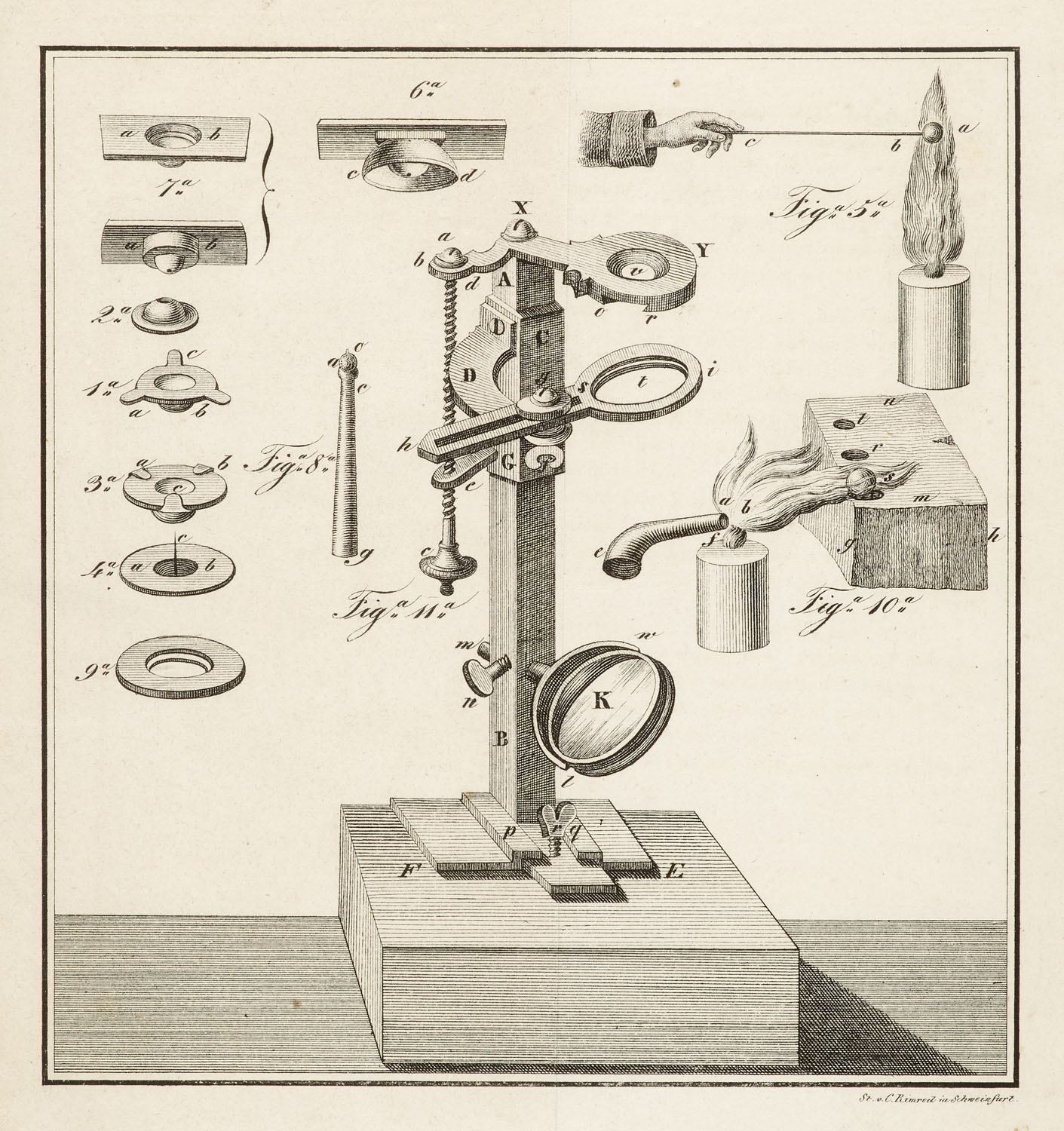
Mikroskopische Beobachtungen über das Gehirn und die damit zusammenhängenden Teile. Aus dem Italienischen ins Deutsche übertragen und mit einer Biographie des Verfassers versehen von J. J. Albrecht von Schoenberg. Mit 1 gefalteter Kupfertafel (Darstellung des Mikroskops). Würzburg, C. Strecker, 1829. 4°. X, 40, (2) S. Ppbd. der Zeit mit goldgeprägtem Rückenschild.
Medizin - Mikroskopie
Naturwissenschaften – Wellcome II, 96. - Ratcliff, The Quest for the Invisible: Microscopy in the Enlightenment, Turnhout 2009, S. 95ff. - Nicht bei Waller. - Exemplar mit dem Exlibris des bedeutenden schwedischen Anatomen und Histologen Gustaf Retzius, der sich zeitlebens intensiv mit der Geschichte der Neuroanatomie und -histologie befasste. Erste und sehr seltene deutsche Übersetzung von Barbas berühmter Studie über das Gehirn, einschließlich der Beschreibung von Della Torres einfachem Mikroskop, den sogenannten "Kügelchen" (auf der Tafel abgebildet). Der Band trägt eine gedruckte Widmung an Samuel Thomas von Soemmerring. Pater Giovanni Maria della Torre gehörte in den frühen 1750er Jahren zu jenen Ordensgeistlichen und Gelehrten, die die aus Glaskügelchen gefertigten einfachen Mikroskope verbesserten. Seine Beobachtung roter Blutkörperchen, die ihm als ein in sechs Säckchen unterteilter Ring erschienen, löste in den 1760er Jahren eine europaweite Kontroverse aus, an der sich Gelehrte aus nahezu allen Ländern beteiligten. In den 1770er Jahren traten neue Anhänger dieser Technik auf den Plan, darunter Barba, Macrì und der Optiker Pater Mazzola, die ebenfalls solche Kügelchen-Mikroskope fertigten. Mit diesen Instrumenten untersuchte Barba, Professor für Physik und Chemie an der neapolitanischen Militärschule, Kryptogamen sowie die Anatomie des Gehirns. Wenig später, in den frühen 1780er Jahren, beanspruchte Mazzola für sich, bereits vor seiner Übersiedlung nach Wien - wo er sich als Optiker niederließ und neue einfache Mikroskope konstruierte - achromatische Objektive entwickelt zu haben (Marc Ratcliff, The Quest for the Invisible: Microscopy in the Enlightenment, 2009, S. 95ff.). Barbas italienisches Original erschien erstmals unter dem Titel Osservazioni microscopiche sul cervello e sue parti adjacenti, Napoli, Stamperia del Corriere di Napoli, 1807, eine zweite italienische Ausgabe folgte 1819. Die vorliegende, von J. J. Albrecht von Schoenberg besorgte deutsche Übertragung von 1829 machte die Untersuchung erstmals einem deutschsprachigen Fachpublikum zugänglich und wurde in der zeitgenössischen physiologischen Literatur rezipiert - so etwa von Christian Gottfried Ehrenberg, der in seiner Schrift über die Struktur des "Seelenorgans" (1839) ausdrücklich auf "Barba, Mikrosk. Beob. über d. Gehirn. 1819. übers. von Schönberg. 1829" verweist.
Natural Sciences – Medicine - Microscopy. - With 1 folding engraved plate (depicting the microscope). Copy with the bookplate of the eminent Swedish anatomist and histologist Gustaf Retzius, who devoted much of his career to the history of neuroanatomy and neurohistology. First and very scarce German translation of Barba's famous study on the brain, including the description of Della Torre's simple microscope, the so-called "spherules" (illustrated on the plate). The volume carries a printed dedication to Samuel Thomas von Soemmerring. In the early 1750s, Father Giovanni Maria della Torre was among the friars and scholars who improved the simple microscopes made from small glass spheres. His observation of red blood cells, which appeared to him as a ring divided into six little sacs, sparked a Europe-wide controversy in the 1760s involving scholars from nearly every country. In the 1770s, new enthusiasts of this technique emerged, among them Barba, Macrì, and the optician Father Mazzola, who likewise produced such spherule microscopes. Using these instruments, Barba-professor of physics and chemistry at the Neapolitan military school-carried out observations of cryptogams as well as of the anatomy of the brain. Shortly afterward, in the early 1780s, Mazzola claimed to have developed achromatic objectives even before his move to Vienna, where he set himself up as an optician and designed new simple microscopes (Marc Ratcliff, *The Quest for the Invisible: Microscopy in the Enlightenment, 2009, pp. 95ff.). Barba's Italian original first appeared under the title *Osservazioni microscopiche sul cervello e sue parti adjacenti*, Naples, Stamperia del Corriere di Napoli, 1807, a second Italian edition followed in 1819. The present German rendering, prepared by J. J. Albrecht von Schoenberg in 1829, made the study accessible to a German-speaking scholarly audience for the first time and was taken up in contemporary physiological literature-for instance by Christian Gottfried Ehrenberg, who, in his treatise on the structure of the "organ of the soul" (1839), explicitly cites "Barba, Mikrosk. Beob. über d. Gehirn. 1819. übers. von Schönberg. 1829.".
Result: 600 €
Premium and taxation
This work is subject to under the regular margin scheme. There is a 24.95% buyer's premium on the hammer price and inside the EU 7% (Books, Paintings, Drawings and most Prints) and 19% (Photographs, Screen and Offsetprints, Autographs and Manuscripts) VAT on the final invoice amount.
Shipping
A pickup of this work is possible in our premises at Potsdamer Str. 16, 14163 Berlin by appointment. If you wish a shipment of the work, please contact us for a consultation and shipping calculation. Framed tickets are shipped exclusively by a shipping company due to the risk of breakage. Postal shipping is only carried out at the express request and risk of the buyer.
Terms and Conditions
You can view our terms and conditions here
Droit de Suite
On the sales proceeds of all original works of fine art and photography, whose authors have not yet died 70 years before the end of the sale, an additional 2% (subject to change) of the hammer prices from 400€ will be charged pro rata for the VG Bild-Kunst, which represents the copyrights of visual artists according to § 26 UrhG.
Submit a bid
I would like to participate in your auction by accepting the General Terms and Conditions of Jeschke Jádi Auctions Berlin GmbH.