Online Catalogue with all Lots / Auction 160
Modern and Contemporary Art
Saturday, 11 July 2026 at 11:00 am - After sale
Lot 125 Robin Page. Etching 1234. (Seascape, …
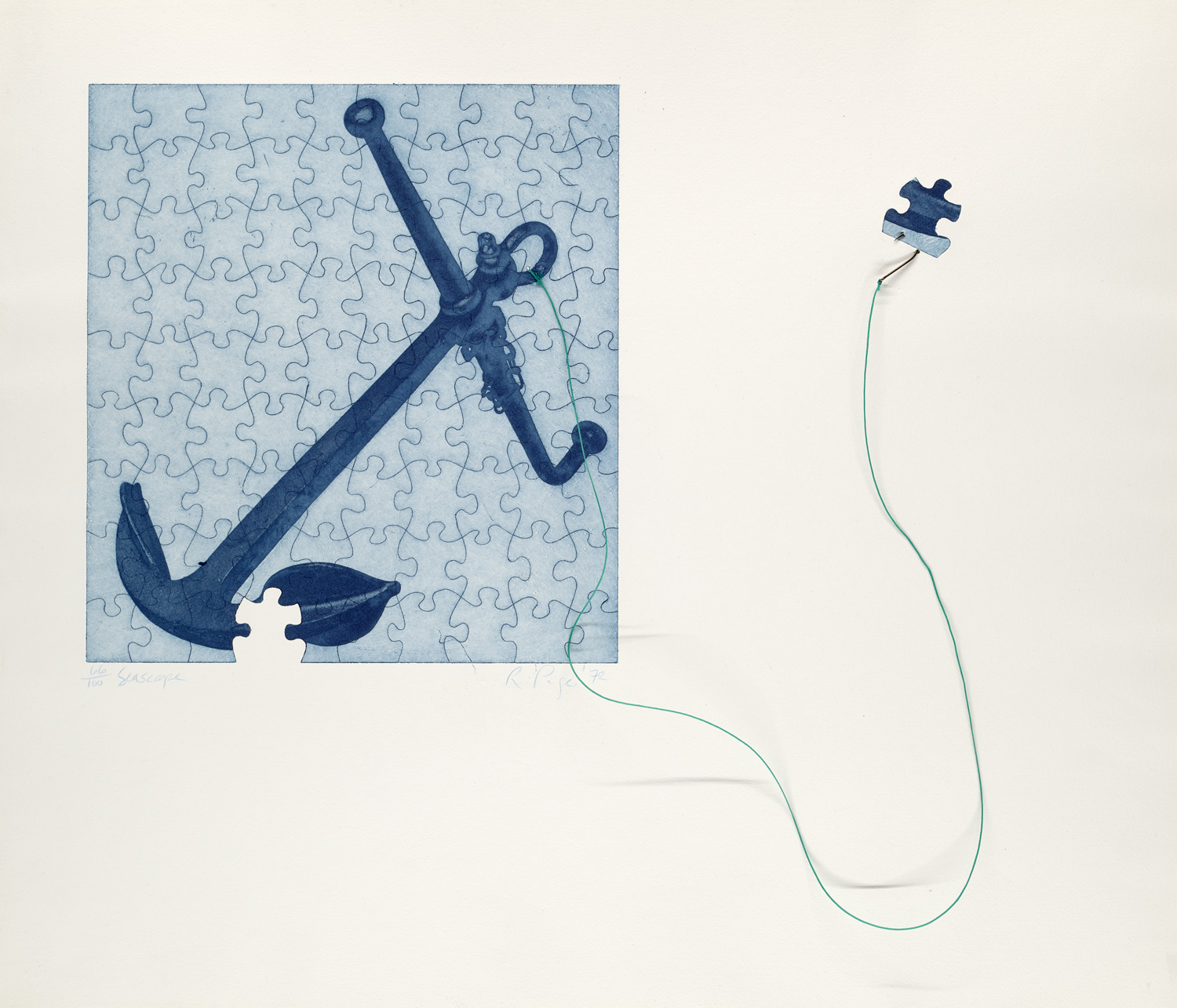
Etching 1234. (Seascape, Landscape, Skyscape und Not yet Sunset.) 1972. Aquatintaradierung, teils Heliogravure und Prägung, teils mit Assemblage. Meist 38 x 48 cm (60 x 70 cm). Signiert, nummeriert und betitelt. Prachtvolle Drucke mit teils leuchtenden Farben.
Fluxus – Vgl. zum Mappenwerk, Staatsgalerie Stuttgart, A 2003/GVL 893. - Eins von 100 Exemplaren. - Robin Pages Radierungen sind als konzeptuelle Antwort eines Fluxus-Künstlers auf die lange Tradition der Landschaftskunst von der Romantik bis zur Moderne zu lesen. Indem Page die Motive Meer, Land, Himmel und Sonnenuntergang in nüchterne, nahezu generische Titel fasst, knüpft er an die sprachlich-bildkritische Strategie Marcel Duchamps an, der den Werktitel als zentrales Medium der Bedeutungsverschiebung einsetzte. Zugleich erinnert die melancholische, scheinbar altmeisterliche Künstlerfigur in "Not yet Sunset" an die Selbstinszenierungen des 19. Jahrhunderts, wird aber - ähnlich wie bei René Magritte - durch den Titel als Reflexion über Wahrnehmung und Bildkonvention entlarvt. Die Serie steht damit quer zur zeitgleichen Pop-Ästhetik und zu lyrischen Landschaften der Nachkriegsmoderne und positioniert sich näher bei Konzeptkunst und "dematerialisierter" Kunstpraxis, wie sie etwa in den 1960er/70er-Jahren von Künstlern wie Hans Haacke oder der Minimal- und Konzeptszene diskutiert wurde. Innerhalb der Fluxus-Bewegung, deren Ziel eine Auflösung der Grenzen zwischen Kunst und Leben war, besetzt Page mit diesen druckgrafischen Blättern eine besondere Rolle, weil er ein traditionelles Medium nutzt, um das Genre selbst ironisch zu unterwandern. In Deutschland steht diese Haltung in einer erweiterten Nachbarschaft zu Joseph Beuys, dessen Aktionen und Objekte ebenfalls auf eine Neukodierung von Natur-, Landschafts- und Wirklichkeitsbegriffen zielten, wenn auch mit stärker politisch-mythologischem Akzent. So bilden Pages "Seascape"-Gruppe und "Not yet Sunset" einen stillen, aber präzisen Kommentar zur Kanonisierung der Landschaft in der Kunstgeschichte - ein grafisches Labor, in dem romantische Sehnsucht, malerische Tradition und konzeptuelle Sprachkritik miteinander kollidieren.
Fluxus – Aquatint etchings, some with heliogravure and embossing, some with assemblage. Signed, numbered, and titled. Magnificent prints, some with vibrant colors. - Robin Page's etchings can be read as the conceptual response of a Fluxus artist to the long tradition of landscape art from Romanticism to modernism. By condensing the motifs of sea, land, sky, and sunset into sober, almost generic titles, Page links up with Marcel Duchamp's linguistic and pictorially critical strategy, in which the work's title functions as a central medium of semantic displacement. At the same time, the melancholic, seemingly old-masterly artist figure in "Not yet Sunset" recalls nineteenth-century self-fashioning, but-much like in René Magritte's work-is exposed by the title as a reflection on perception and pictorial convention. The series thus cuts across contemporary Pop aesthetics and the lyrical landscapes of the post-war period, aligning itself more closely with conceptual art and "dematerialized" artistic practices as discussed in the 1960s and 1970s by artists such as Hans Haacke and within the Minimal and Conceptual scenes. Within the Fluxus movement, whose aim was to dissolve the boundaries between art and life, Page occupies a particular position with these prints because he uses a traditional medium to undermine the genre itself with irony. In the German context, this stance can be seen in an extended proximity to Joseph Beuys, whose actions and objects likewise sought to recode notions of nature, landscape, and reality, albeit with a more pronounced political-mythological charge. In this way, Page's "Seascape" group and "Not yet Sunset" form a quiet yet precise commentary on the canonization of landscape within art history-a graphic laboratory in which romantic longing, painterly tradition, and conceptual critique of language collide.
Result: 450 € (Under reservation)
Post Auction Price: 500 €
Premium and taxation
This piece is subject to differential taxation. There is a 29,5% buyer's premium on the hammer price. The value added tax is included but not displayable according to §25a UstG.
Shipping
A pickup of this work is possible in our premises at Potsdamer Str. 16, 14163 Berlin by appointment. If you wish a shipment of the work, please contact us for a consultation and shipping calculation. Framed tickets are shipped exclusively by a shipping company due to the risk of breakage. Postal shipping is only carried out at the express request and risk of the buyer.
Terms and Conditions
You can view our terms and conditions here
Droit de Suite
On the sales proceeds of all original works of fine art and photography, whose authors have not yet died 70 years before the end of the sale, an additional 2% (subject to change) of the hammer prices from 400€ will be charged pro rata for the VG Bild-Kunst, which represents the copyrights of visual artists according to § 26 UrhG.
Submit a bid
I would like to participate in your auction by accepting the General Terms and Conditions of Jeschke van Vliet Auctions Berlin GmbH.